
7 min read
Spaced Repetition, Explained: Why Later Beats Longer
Cramming fades fast. Over a century of memory research shows that reviewing at growing gaps keeps words for months. Here's how to time your reviews.
- learning-science
- spaced-repetition
- vocabulary
You learn a new word on Monday. You know it on Tuesday. By next Monday it has gone, and you are sure you studied it. That isn't a sign you are bad at languages. It's how memory works, and it is one of the best-studied effects in psychology. The good news is that the same research tells you how to beat it: review a little, a little later, and then a little later again. That is spaced repetition.
Forgetting has a shape
In the 1880s the German psychologist Hermann Ebbinghaus memorised lists of nonsense syllables, then measured how long it took him to relearn them after different delays. Plotted out, his results make the famous forgetting curve: we lose a lot soon after learning, and after that the loss slows down.
Ebbinghaus tested one person, himself, so you might wonder whether the curve holds up. In 2015 two researchers repeated his method. One participant spent 70 hours learning lists and relearning them after 20 minutes, an hour, 9 hours, a day, 2 days and 31 days. The results came out close to Ebbinghaus's own, with one twist: the curve isn't perfectly smooth, and it probably jumps upward at the one-day mark (Murre & Dros, 2015).
The shape is the useful part. If most forgetting happens early, a review that comes at the right moment catches a memory before it is lost, and each review makes it last longer.
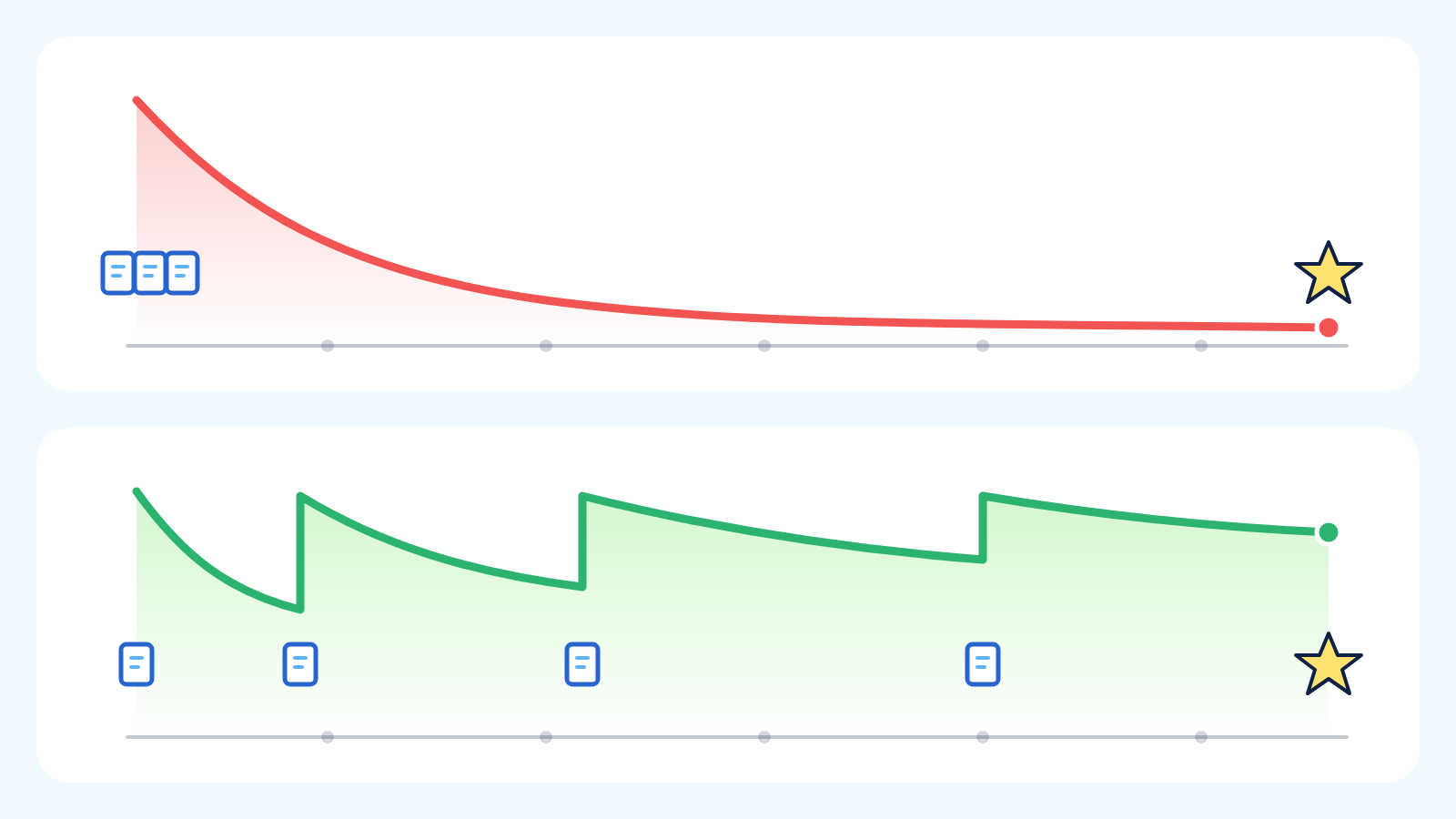
An illustration of the idea, not measured data. Top: three study sessions crammed together, then a long wait. Bottom: the same effort spread out as reviews, each one bringing the memory back before it fades.
What the research says
Spacing beats cramming, almost everywhere
The biggest summary of the evidence is a 2006 meta-analysis by Nicholas Cepeda and colleagues. They gathered 839 measurements of distributed practice from 317 experiments in 184 published articles. Spreading study out beat massing it together, and the best gap between sessions grew as the time until the test grew (Cepeda et al., 2006).
That finding holds for language learning in particular. A 2022 meta-analysis of second-language studies pulled 98 effect sizes from 48 experiments with 3,411 learners. Spacing had a medium-to-large effect on how much they learned (Kim & Webb, 2022).
When a team of learning scientists rated ten popular study techniques for how well they work across ages, subjects and settings, only two earned their top rating: practice testing and distributed practice. Rereading and highlighting, the two that students lean on most, were rated low (Dunlosky et al., 2013).
How long should you wait?
This is the question everyone asks, and one large study gives a practical answer. Cepeda and colleagues taught more than 1,350 people a set of facts, gave them one review after a gap of up to three and a half months, and tested them up to a year later. At every test delay, lengthening the gap first helped and then slowly hurt, so there is a sweet spot. And the sweet spot depends on how long you need to remember (Cepeda et al., 2008):
- For a test one week away, the best gap was about 20 to 40% of that week: review after roughly one and a half to three days.
- For a test one year away, the best gap was about 5 to 10% of the year: roughly 18 to 36 days.
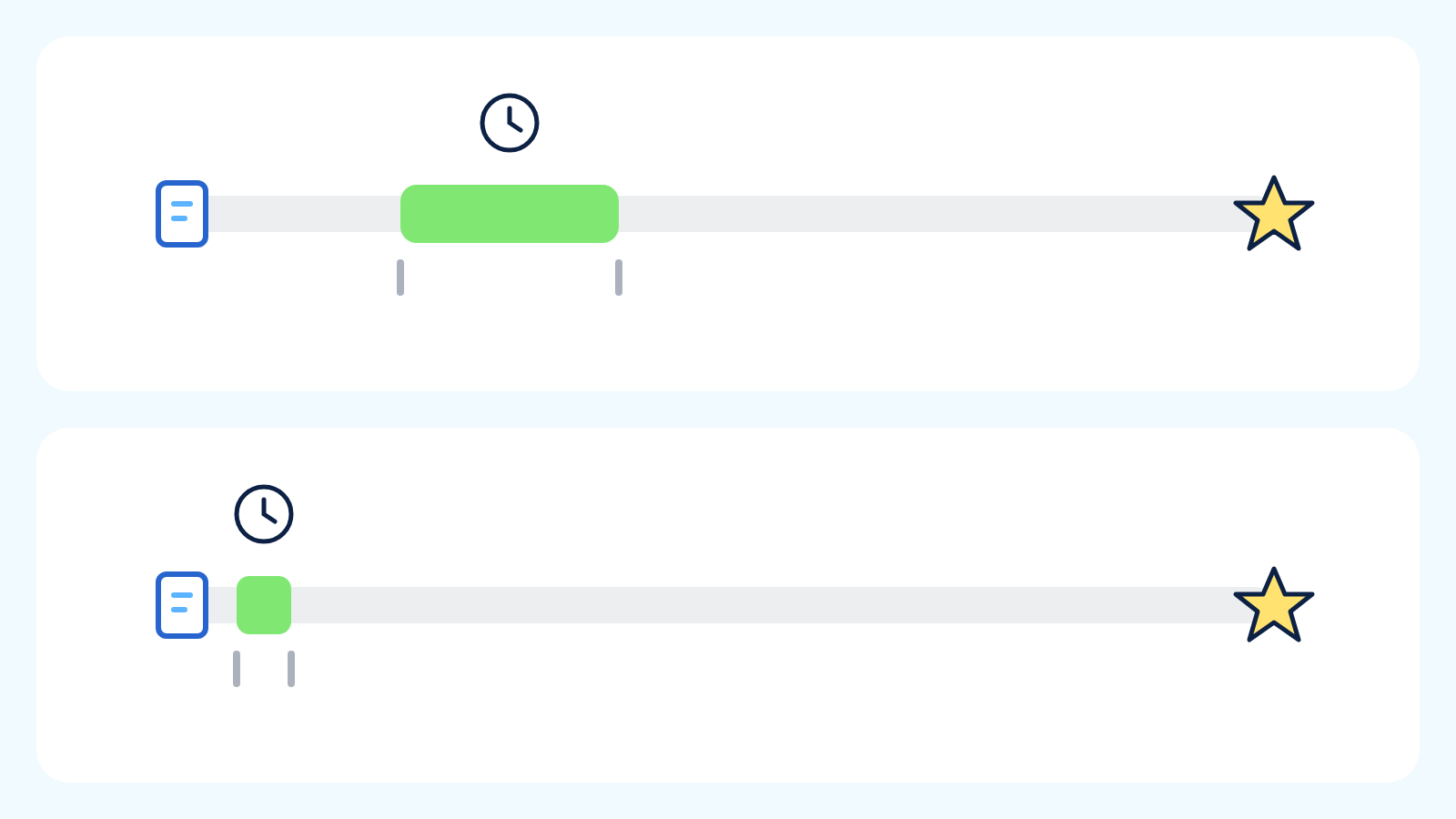
The best time for a review, from Cepeda et al. (2008). Each bar runs from first study (the card) to the final test (the star). Top: a test one week away, best review 20 to 40% of the way there. Bottom: a test one year away, best review 5 to 10% of the way there.
So if you want a word for keeps, the gaps should stretch out to weeks. Reviewing every day forever wastes time on words you already know.
Fewer sessions, better timed
The longest-running test of this with foreign-language words is a nine-year study by the Bahrick family. Four people learned 300 foreign words each, then relearned them in 13 or 26 sessions spaced 14, 28 or 56 days apart, and were tested up to five years after training ended. The longer gaps made learning a little slower, but retention was clearly higher. Thirteen sessions 56 days apart did about as well as 26 sessions 14 days apart (Bahrick et al., 1993). In other words, half the sessions, well spaced, gave the same result. It was only four people, but they were tested over years, which few studies manage.
What is still open
Many apps and guides use expanding gaps (one day, then three, then a week, and so on). That sounds right, but the evidence is mixed. In the 2022 language-learning meta-analysis, expanding and equal gaps came out statistically the same (Kim & Webb, 2022). What clearly matters is spacing at all, and longer gaps when you want to remember for longer. The exact pattern matters less.
How to use it today
- Review tomorrow, not tonight. Rereading a list straight after you learn it feels productive, but it's massed practice. Close the book and come back after a night's sleep.
- Test yourself instead of rereading. Cover the answer and try to recall it before you look. Spacing and self-testing were the two techniques rated highest by Dunlosky and colleagues, and they work well together.
- Stretch the gap when you get it right. If you remember ありがとう (arigatō, "thank you") easily after a day, wait several days before you see it again, then a couple of weeks. If you miss it, bring the gap back in. Whether the steps grow or stay even matters less than leaving them.
- Match the gap to your goal. A quiz a week from now? Review about two days after you first study the words. Want 감사합니다 (gamsahamnida), 谢谢 (xièxie) or gracias to still be there next year? Let your reviews spread out to several weeks apart.
- Expect it to feel a bit harder. In the Bahrick study, longer gaps made learning slightly slower in the moment and paid off later. Struggling to pull up a word after a long gap isn't failure. It's often the review doing its job.
- Keep sessions short and regular. Ten minutes of due reviews most days beats one long weekend session, because each review lands at a different point on the forgetting curve.
Even Luffy takes breaks on his way up the Great Wall. Rest stops are part of a long climb.
Try it in Miaru
Miaru builds spaced repetition into every course, so you don't have to keep a calendar. Each character, word and sentence you learn gets its own review schedule. When something is due, it comes back on its own at the start of your later lessons, and you can run a quick review round of up to 15 due items whenever you like. Get one right and it stays away longer. Miss it and it comes back sooner.
References
- Bahrick, H. P., Bahrick, L. E., Bahrick, A. S., & Bahrick, P. E. (1993). Maintenance of foreign language vocabulary and the spacing effect. Psychological Science, 4(5), 316–321. https://doi.org/10.1111/j.1467-9280.1993.tb00571.x
- Cepeda, N. J., Pashler, H., Vul, E., Wixted, J. T., & Rohrer, D. (2006). Distributed practice in verbal recall tasks: A review and quantitative synthesis. Psychological Bulletin, 132(3), 354–380. https://doi.org/10.1037/0033-2909.132.3.354
- Cepeda, N. J., Vul, E., Rohrer, D., Wixted, J. T., & Pashler, H. (2008). Spacing effects in learning: A temporal ridgeline of optimal retention. Psychological Science, 19(11), 1095–1102. https://doi.org/10.1111/j.1467-9280.2008.02209.x
- Dunlosky, J., Rawson, K. A., Marsh, E. J., Nathan, M. J., & Willingham, D. T. (2013). Improving students' learning with effective learning techniques: Promising directions from cognitive and educational psychology. Psychological Science in the Public Interest, 14(1), 4–58. https://doi.org/10.1177/1529100612453266
- Kim, S. K., & Webb, S. (2022). The effects of spaced practice on second language learning: A meta-analysis. Language Learning, 72(1), 269–319. https://doi.org/10.1111/lang.12479
- Murre, J. M. J., & Dros, J. (2015). Replication and analysis of Ebbinghaus' forgetting curve. PLOS ONE, 10(7), e0120644. https://doi.org/10.1371/journal.pone.0120644
