
7 min read
Retrieval Practice: Why Testing Yourself Beats Rereading
Rereading feels like learning, but pulling a word out of memory is what makes it stick. What the research shows, and how to practise recall every day.
- learning-science
- retrieval-practice
- vocabulary
You read the new words again. You read them once more on the bus. They look familiar, so it feels like they are going in. Then someone asks you how to say "boat", and nothing comes. That feeling of familiarity was real, but it wasn't memory. The research on this is clear and a little surprising: the fastest way to remember a word is to practise pulling it out of your head, not to keep putting it in. Psychologists call this retrieval practice, or the testing effect.
Here is what the studies found, and how to use it from today.
What the research says
A week later, the students who tested themselves won
In a well-known 2006 study, Henry Roediger and Jeffrey Karpicke gave students short prose passages to learn, one about the sun and one about sea otters. Some read a passage four times. Others read it once and then tried to write down everything they remembered, three times, with no feedback. Then everyone took a final test, either five minutes later or a week later (Roediger & Karpicke, 2006).
Five minutes later, rereading looked better: the readers recalled 83% of the ideas and the testers 71%. A week later, it flipped. The testers recalled 61% and the readers only 40%, even though the readers had read the passage about 14 times in all and the testers about 3. The students who reread were also more confident that they would remember it.
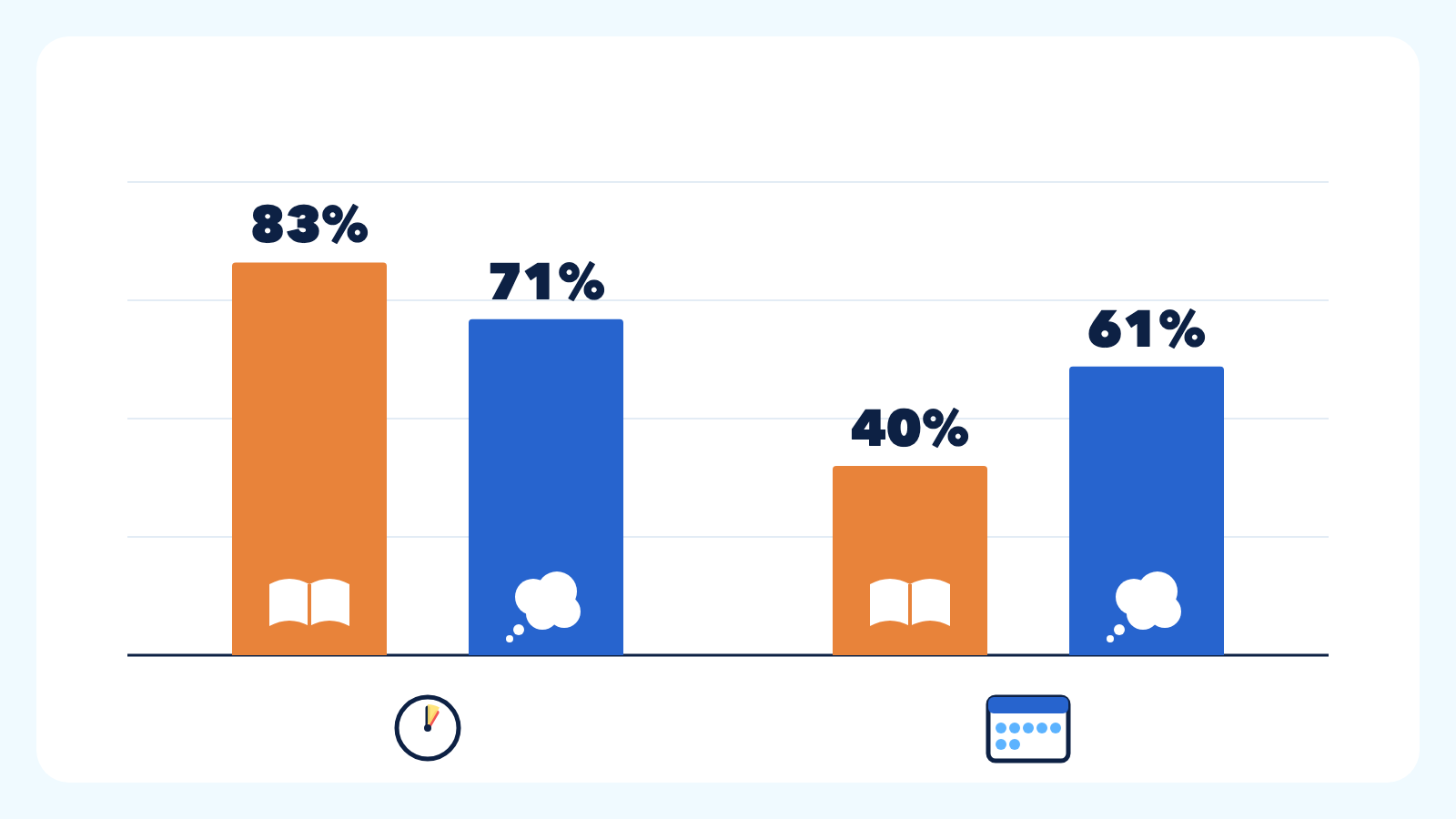
Share of the passage recalled on the final test, from Roediger and Karpicke (2006), Experiment 2. Rereading wins if the test is five minutes away. Testing yourself wins if it is a week away.
That is the trap. Rereading gives you a quick boost that you can feel, so it seems to work. Recall builds memory that lasts, but while you are doing it, it feels harder.
Forty Swahili words, and the mistake most learners make
Two years later the same researchers tested this with foreign vocabulary. Students learned 40 Swahili–English word pairs, such as mashua – boat, in rounds of studying and testing. The twist came after a student got a word right for the first time. In some groups that word kept appearing on later tests. In others it was dropped from testing, the way many of us drop a flashcard once we "know" it (Karpicke & Roediger, 2008).
A week later, the students who had kept testing themselves on every word recalled about 80% of the pairs. The students whose words were dropped from testing recalled only 36% and 33%. Restudying the words more often made almost no difference. Being asked for them again did. And when the students guessed how many words they would remember a week later, every group guessed about half. Nobody could feel the difference from the inside.
It works when the words are new, and when you say them aloud
A study of English speakers learning Spanish words showed the same thing on a small scale. Learners saw pictures paired with new Spanish words. For half of the words there was a six-second pause between the picture and the word, so they could try to recall it first. Those words scored higher on tests right away, two days later and a week later (Barcroft, 2007).
Speaking is no exception. Many courses ask you to listen to a native speaker and repeat. In two experiments, learners saw pictures of objects and heard their names in a new language. For some words they repeated the name after hearing it. For others they tried to say it from memory first, then heard it. Trying first gave better understanding of the words and better ability to say them, with no loss in pronunciation (Kang, Gollan & Pashler, 2013).
Getting it wrong still helps
Retrieval practice can feel discouraging when you can't come up with the answer. The good news is that a failed attempt still counts. In a series of experiments, people who tried to answer a question before seeing the answer learned it better than people who just read the question and answer together, even when their guess was wrong (Kornell, Hays & Bjork, 2009). Reaching for a word and missing it prepares you to keep it when you see it.
How strong is the evidence?
Very strong, by the standards of education research. A 2017 meta-analysis that pooled studies of practice testing found that it beat restudying, and every other comparison condition, for learning (Adesope, Trevisan & Sundararajan, 2017). Another review found that tests where you produce the answer yourself help more than tests where you only recognise it from a list (Rowland, 2014). And when a team of learning scientists rated ten popular study techniques, practice testing was one of only two that earned their top rating. The other was spaced repetition (Dunlosky et al., 2013).
How to use it today
- Close the book, then recall. After you study a list, cover it and write or say every word you can remember before you look again. The gap between what you recalled and what was there is your next study list.
- Produce, don't just recognise. Picking 水 from four options is good. Saying mizu ("water") when you see a picture of a glass is better. Use your target language as the answer side as often as you can.
- Say it before you hear it. With audio, pause before the speaker and try the word yourself, then listen and compare. That beats repeating after them.
- Don't retire a word after one right answer. In the Swahili study, testing a word again after it was learned was what made it stick. Keep it in your reviews, just less often.
- Guess, then check right away. A wrong guess followed by the answer still helps, so have a go before you look, and always check what you missed.
- Space it out. Testing yourself and spaced repetition work well together: quiz yourself tomorrow, then in a few days, then next week.
Luffy does it the same way: book shut, card still face down, and the boat already in his head before he turns it over.
Try it in Miaru
Miaru is built around recall, not rereading. Most of a lesson is you answering: matching words to their meanings, building sentences from a word bank, translating, choosing the right answer, and talking your way through short conversations. You find out right away whether you got it. The characters, words and sentences you learn also come back for review in later lessons, so you keep being asked for them after you first get them right.
References
- Adesope, O. O., Trevisan, D. A., & Sundararajan, N. (2017). Rethinking the use of tests: A meta-analysis of practice testing. Review of Educational Research, 87(3), 659–701. https://doi.org/10.3102/0034654316689306
- Barcroft, J. (2007). Effects of opportunities for word retrieval during second language vocabulary learning. Language Learning, 57(1), 35–56. https://doi.org/10.1111/j.1467-9922.2007.00398.x
- Dunlosky, J., Rawson, K. A., Marsh, E. J., Nathan, M. J., & Willingham, D. T. (2013). Improving students' learning with effective learning techniques: Promising directions from cognitive and educational psychology. Psychological Science in the Public Interest, 14(1), 4–58. https://doi.org/10.1177/1529100612453266
- Kang, S. H. K., Gollan, T. H., & Pashler, H. (2013). Don't just repeat after me: Retrieval practice is better than imitation for foreign vocabulary learning. Psychonomic Bulletin & Review, 20(6), 1259–1265. https://doi.org/10.3758/s13423-013-0450-z
- Karpicke, J. D., & Roediger, H. L. (2008). The critical importance of retrieval for learning. Science, 319(5865), 966–968. https://doi.org/10.1126/science.1152408
- Kornell, N., Hays, M. J., & Bjork, R. A. (2009). Unsuccessful retrieval attempts enhance subsequent learning. Journal of Experimental Psychology: Learning, Memory, and Cognition, 35(4), 989–998. https://doi.org/10.1037/a0015729
- Roediger, H. L., & Karpicke, J. D. (2006). Test-enhanced learning: Taking memory tests improves long-term retention. Psychological Science, 17(3), 249–255. https://doi.org/10.1111/j.1467-9280.2006.01693.x
- Rowland, C. A. (2014). The effect of testing versus restudy on retention: A meta-analytic review of the testing effect. Psychological Bulletin, 140(6), 1432–1463. https://doi.org/10.1037/a0037559
