
7 min read
Comprehensible Input: What the Research Really Says
Is understanding lots of input all you need to learn a language? What Krashen claimed, what the research found, and how to use input, output and feedback.
- learning-science
- input
- speaking
Here is one of the most popular ideas in language learning: you don't learn a language by studying it, you pick it up by understanding it. Listen and read a lot, at a level you can follow, and the grammar will take care of itself. Speaking will come when you are ready.
That idea has a name, comprehensible input, and it comes with a famous formula, i + 1. It is a good idea. It is also not the whole story. Here is what its author actually claimed, what four decades of research found, and how to use input well without leaving out the parts that make it work.
What Krashen actually claimed
The linguist Stephen Krashen set out the idea in a 1982 book. Its core is the input hypothesis: if you are at some stage of a language, call it i, you move to the next one by understanding input that contains structure "a little beyond" where you are now, i + 1. You understand those new structures with help from context, from what you already know about the world, and from pictures and situations, not by having them explained. And you do not need to aim at i + 1 on purpose: when you understand the input and there is enough of it, the next step is in there automatically (Krashen, 1982).
Two more claims came with it, and they are the bold ones. First, the book separates acquisition, the unconscious process that comes from understanding messages, from learning, the conscious knowledge of rules. Conscious learning, Krashen argued, works only as a "Monitor", an editor that can tweak what you say when you have time to think about form. Second, speaking cannot be taught directly. In his words, production ability "emerges" over time, on its own, once enough input has gone in.
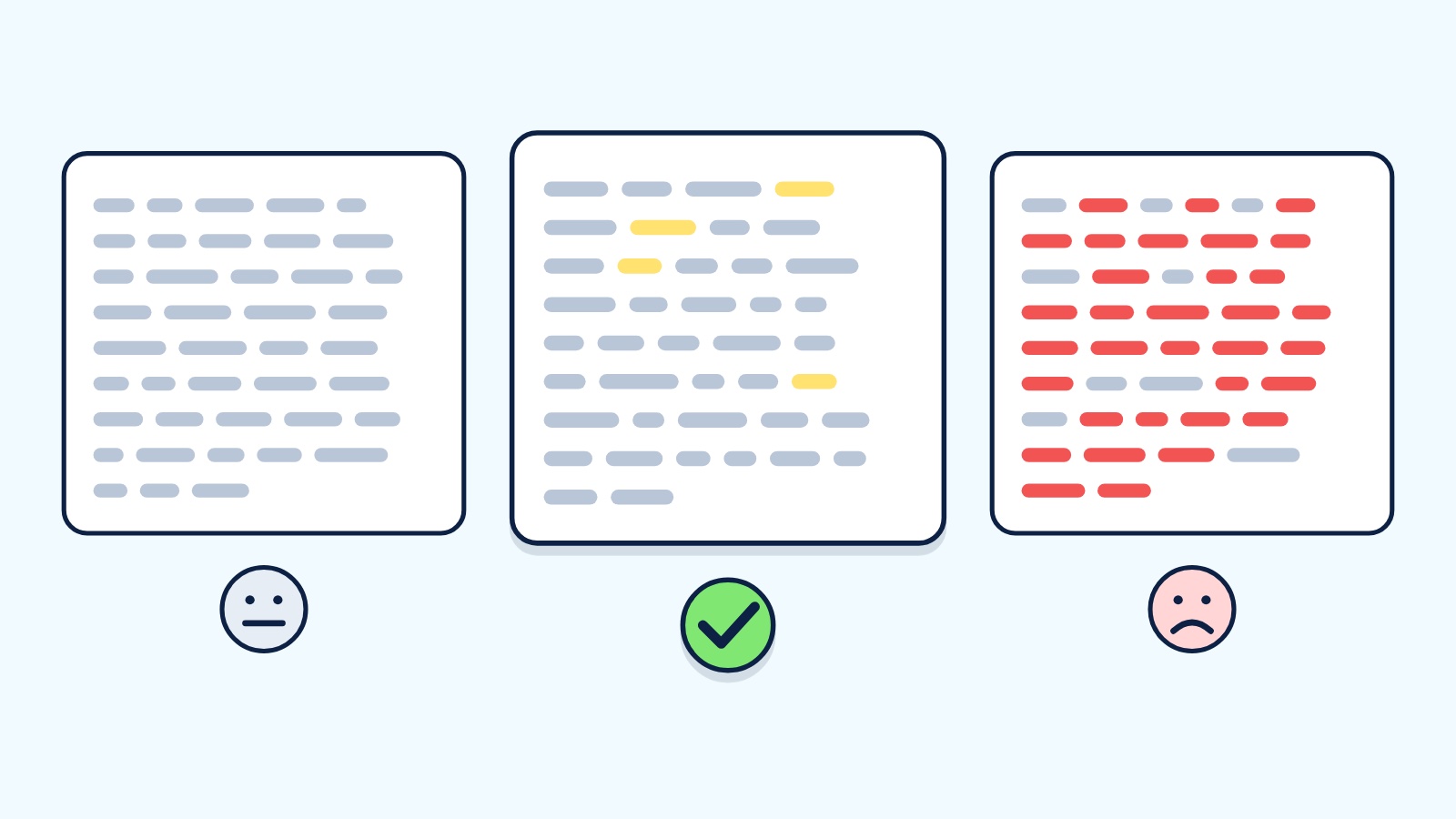
The idea behind i + 1: input that is all familiar teaches little, input that is mostly new can't be followed, and the useful middle is mostly familiar with a few new things you can work out from context (after Krashen, 1982). An illustration, not data.
What the research found
Lots of understandable input really does help
The most direct test of "read a lot at your level" is extensive reading: learners read many easy books of their own choosing, for meaning and for pleasure. Takayuki Nakanishi pulled together 34 studies with almost 4,000 learners. Students who did extensive reading outperformed those who did not, with a medium effect (d = 0.46), and readers' scores rose by a larger margin (d = 0.71) from before to after the reading program. The conclusion: extensive reading improves reading proficiency and belongs in language courses (Nakanishi, 2015).
So the first half of the idea holds up. Understandable input, and a lot of it, is good for you. The trouble starts with the claim that it is all you need.
Teaching the rules helps too
If conscious learning were only a light editor, teaching grammar on purpose should not do much. John Norris and Lourdes Ortega tested that across 49 experimental studies of language instruction published between 1980 and 1998. Focused instruction led to large gains on the features it targeted. Explicit teaching, where the rule is explained or learners are asked to work it out, was more effective than implicit teaching. And the gains were durable: they lasted on delayed tests, not just the day after (Norris & Ortega, 2000). The authors also note limits: the studies measured learning in different ways, and the field still needed better replication. But "rules don't matter" is hard to square with these results.
Speaking is not only the result of learning, it is part of it
Merrill Swain proposed what became known as the output hypothesis: producing language does work that understanding it does not. In a study of her own with Sharon Lapkin, she argued that when learners speak or write, they sometimes notice a problem, a word they don't have or a sentence they can't finish. Noticing it pushes them to change what they say, and that pushes them into a more grammatical kind of processing than they need for simply understanding. What happens between the first attempt and the fixed one, they suggest, is part of learning itself (Swain & Lapkin, 1995).
That is a very different picture from "speaking emerges on its own". When you are listening, you can often get the meaning while skipping over the grammar. When you have to say it, there is nowhere to hide.
Feedback on mistakes makes a difference
If speaking reveals gaps, feedback is what fills them. Roy Lyster and Kazuya Saito combined 15 classroom studies with 827 learners on oral corrective feedback: a teacher reacting to a mistake while the learner is talking. Feedback had significant, durable effects on learners' language. Prompts, which push learners to fix the mistake themselves, worked better than recasts, where the teacher simply says the correct version. And younger learners gained more from feedback than older ones (Lyster & Saito, 2010).
So who was right?
Both camps, partly. The evidence backs Krashen on the importance of a lot of understandable input. But it does not back the stronger claims that input is enough, that teaching rules does little, and that speaking will take care of itself. The most useful reading of the research is a loop: understand a lot, try to say things, notice where you get stuck, get feedback, and go back to input with sharper ears.
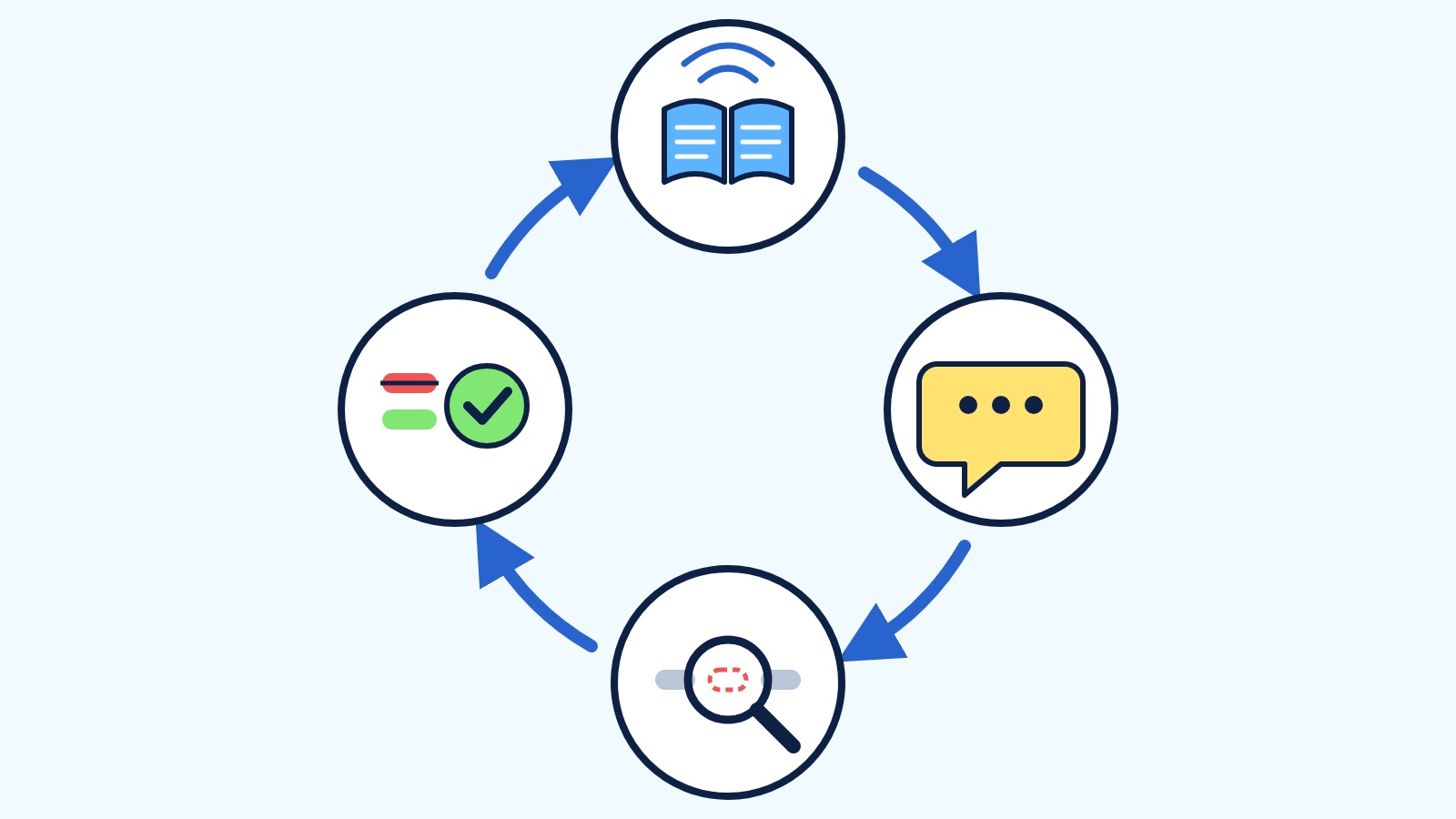
Input, output, noticing and feedback as one loop, drawn from the studies above: input matters (Nakanishi, 2015), speaking makes you notice gaps (Swain & Lapkin, 1995), and feedback helps fix them (Lyster & Saito, 2010).
How to use comprehensible input today
- Find your level, then stay slightly above it. Good input is mostly familiar with a few new things you can work out. If you understand nothing, it is noise; if you understand everything, step up. How much you need to know for a text to feel easy depends on your vocabulary, which is why the number of words you know matters so much.
- Get a lot of it. Volume is the whole point. Graded readers, children's books, podcasts for learners and shows you have already seen in your own language all count.
- Use context on purpose. Pictures, a story you already know, a video with the sound on: Krashen's point that context carries meaning is one of his best. Choose input with plenty of it.
- Talk early, even badly. Don't wait for speech to "emerge". Say a few sentences about what you just read or heard. The moment you get stuck is the moment you find out what to learn next.
- Look up the rule when a pattern keeps tripping you. A short explanation is not cheating. The meta-analysis above says it helps, and it makes the next round of input easier to follow.
- Get feedback, and try to fix it yourself first. When a teacher, a friend or an app flags a mistake, have a go at correcting it before you look at the answer. That is the "prompt" that beat simply hearing the correct version.
Try it in Miaru
Miaru is built around that loop. A lesson starts by showing you its new words, with a tap to hear each one, then asks you to use them, and after every answer you see whether you were right, with the correct answer when you weren't. For speaking, Miaru Plus adds calls where you say your lines out loud and see how they score; here is how speaking practice works. On the cover, Luffy climbs a staircase of books, each step just one book higher than the last, while AI floats over the tallest stack with a speech bubble that holds a picture instead of words.
References
- Krashen, S. D. (1982). Principles and practice in second language acquisition. Pergamon. https://www.sdkrashen.com/content/books/principles_and_practice.pdf
- Lyster, R., & Saito, K. (2010). Oral feedback in classroom SLA: A meta-analysis. Studies in Second Language Acquisition, 32(2), 265–302. https://doi.org/10.1017/S0272263109990520
- Nakanishi, T. (2015). A meta-analysis of extensive reading research. TESOL Quarterly, 49(1), 6–37. https://doi.org/10.1002/tesq.157
- Norris, J. M., & Ortega, L. (2000). Effectiveness of L2 instruction: A research synthesis and quantitative meta-analysis. Language Learning, 50(3), 417–528. https://doi.org/10.1111/0023-8333.00136
- Swain, M., & Lapkin, S. (1995). Problems in output and the cognitive processes they generate: A step towards second language learning. Applied Linguistics, 16(3), 371–391. https://doi.org/10.1093/applin/16.3.371
