
8 min read
Luffy Is Calling: How Speaking Practice Works in Miaru
Everyday Conversations turns lessons into calls with Luffy: say your lines out loud, get each one scored on your phone, try again. Here's how it works.
- miaru
- speaking
- pronunciation
Most language learners can read far more than they can say. You have met perdón or すみません a dozen times in lessons, you would pick it out of a list in a second, and yet the first time you need to say it to a real person, your mouth goes blank. Recognizing a line and saying it are two different skills, and only one of them gets practiced when you tap answers on a screen.
That is why Miaru 1.4.0 added Everyday Conversations: calls with Luffy and friends where you say your lines out loud and get each one scored. This post explains how a call works, what the score means, and why speaking practice deserves a place in your routine.
Why say it out loud?
A few well-studied findings explain why speaking a line beats reading it silently.
- Saying a word helps you remember it. In eight experiments, words people read aloud were remembered better than words they read silently. The researchers call it the production effect (MacLeod et al., 2010). One honest caveat: the effect showed up when some words were said aloud and others were read silently, so it works by making the spoken ones stand out.
- Say it before you hear it. Learners who tried to say a new word from memory before hearing it learned it better than learners who simply repeated after a speaker. They understood and produced the words better two days later, and their pronunciation was no worse (Kang, Gollan & Pashler, 2013). It is the same idea as retrieval practice, applied to your voice.
- Pronunciation practice works, especially with feedback. A meta-analysis of 86 studies found a generally large effect for pronunciation instruction, with bigger gains when learners got feedback and when the training ran longer (Lee, Jang & Plonsky, 2015).
- Speech recognition can be that feedback. Across 15 studies, practicing with automatic speech recognition (ASR) had a medium overall effect on learners' pronunciation (g = 0.69). Explicit corrective feedback worked best, individual sounds improved more than intonation, and very short use made no difference (Ngo, Chen & Lai, 2024).
- Nerves get in the way. Across 97 reports and almost 20,000 learners, higher language anxiety went with lower achievement (r = −.36). That is a correlation, not proof that one causes the other (Teimouri, Goetze & Plonsky, 2019). Even so, rehearsing out loud with a friendly cartoon monkey is a gentler first step than a stranger at a counter.
How a call works
Every Everyday Conversations lesson comes with a call. The call takes the conversation from that lesson, a greeting or ordering a drink at a café, and turns it into a phone call. Your partner says their lines and you say yours.
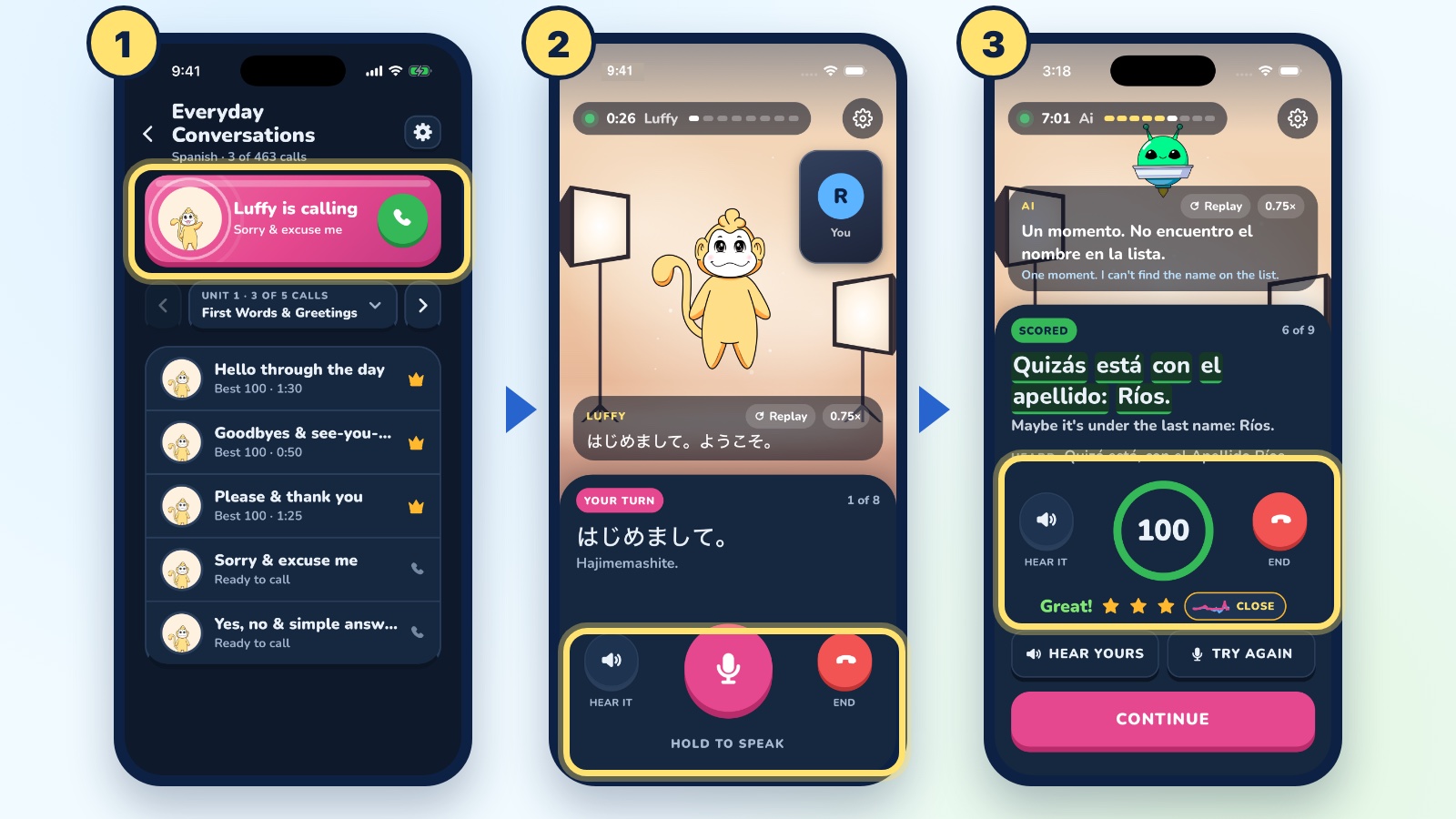
Real screens from Miaru 1.4.0: (1) the call log, (2) your turn on a call with Luffy, (3) a line scored 100.
1. Someone is calling
On a course's screen, a card shows when a call is ready. Finish an Everyday Conversations lesson and its call is waiting for you: New in the unit you are working on, Missed in older ones. The call log groups every call by unit and keeps your best run, its score and how long it took. A crown marks a perfect 100. You can open any call at any time, even for a lesson you have not finished yet.
2. Listen to your partner
Your partner is Luffy, Ai (the little green alien on his flying saucer) or Yuko. Their line appears on screen with its translation in your language. Tap Replay to hear it again, or 0.75× to hear it slowly. In the call settings you can make your partner speak slower or faster, and choose what the lines show. For Japanese that is kanji, furigana, romaji and the meaning. Korean offers Hangul and romanization, and Mandarin hanzi and pinyin.
3. Your turn
When it is your turn, your line appears, and by default the app plays it for you first. Then hold the pink button and say it (if you prefer, switch to tap-to-speak in the settings). Hear it plays the line again if you want another listen.
4. How a line is scored
Each line gets a score from 0 to 100.
- 80% is the words. Were the sounds of the line heard, in the right order?
- 20% is pace. Take up to 1.6 times as long as the recording and you lose nothing. Slower than that, the pace part shrinks.
- Missing words cap the score. One word only partly heard caps it at 89, one word missed at 74, and a word left out or two words missed at 59. Saying a different line from the call caps it at 45.
The words light up as they were heard. Green means heard, gold means only partly heard, and red means not heard. Under the line you can see what your partner heard you say. Then the stars: one star at 60 (a pass), two at 70, three at 90. Tap Hear yours to play back your own try and compare it with the recording.
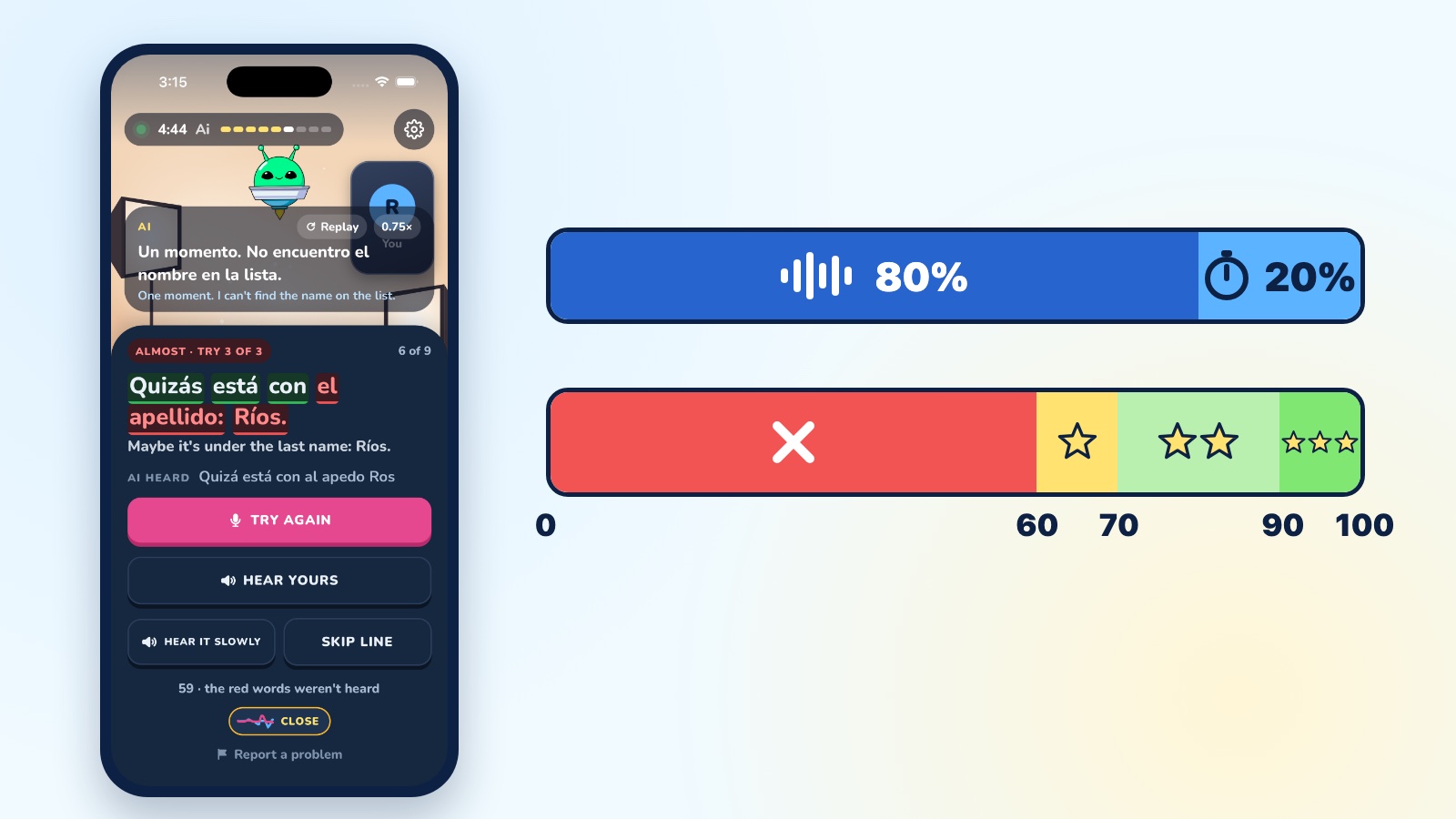
Left: a line on its third try, with the words that weren't heard in red. Right: how the score is built (80% words, 20% pace) and where the stars start.
5. Try again, or move on
When a line doesn't pass, Try again, Hear yours and Hear it slowly are right there. You get three tries per line, and after the third, Skip line lets you move on. Strict mode is on by default, so the call moves on only when a line scores 75 or more. Turn it off and 60 is enough.
6. The melody check
Words are only half of sounding natural; the other half is the rise and fall of your voice. After each line a small chip compares your pitch with the recording's: On key, Close or Off key. Tap it to see both melodies drawn on top of each other: blue for the recording, pink for you. Intonation is hard to judge by machine (the ASR studies above saw smaller gains there too), so the check only ever costs you one thing. A completely flat voice can't earn a third star. Everything else it says is advice.
7. What a call earns
A finished call earns 1 XP, plus 1 XP for every line you passed, and the same number of sapphires. Calls count toward your streak and your weekly league. Calling again only pays for beating your best, so it is worth coming back to an old call to chase that crown.
Your voice stays on your phone
Miaru listens on the phone itself. Before your first call in a language, the app downloads a speech model for that language once. From then on, your voice is turned into text right on your phone, and only the words it heard and your scores reach Miaru. Recordings are never kept or used to train AI. The one exception is a line you choose to report because it was misheard, which you can send to us with its recording.
How to get the most out of a call
- Say it from memory first. Once a conversation feels familiar, turn off "Play my line first" in the call settings. Try your line before you hear it, then tap Hear it to check. That is the retrieval-over-imitation finding in action.
- Use Hear yours. Listen to your try right after the recording. Your own ear is a second source of feedback.
- Chase the melody, not just the words. If the chip says Off key, open it and copy the shape of the blue line: where it rises, where it falls.
- Come back to old calls. A call you aced last week is a good warm-up today, and spacing practice out beats cramming it, as our post on how Miaru brings your words back explains.
- Keep it low-stakes. Three tries, a skip button and no one watching. Mistakes on a call cost nothing, and that is the point.
Try it in Miaru
Everyday Conversations is part of Miaru Plus, in the Miaru app for iPhone and Android, in every course. Learners on the free plan can see the calls in their course and find out what Plus includes. Pick up when Luffy calls, say your first line out loud, and see how it scores.
References
- Kang, S. H. K., Gollan, T. H., & Pashler, H. (2013). Don't just repeat after me: Retrieval practice is better than imitation for foreign vocabulary learning. Psychonomic Bulletin & Review, 20(6), 1259–1265. https://doi.org/10.3758/s13423-013-0450-z
- Lee, J., Jang, J., & Plonsky, L. (2015). The effectiveness of second language pronunciation instruction: A meta-analysis. Applied Linguistics, 36(3), 345–366. https://doi.org/10.1093/applin/amu040
- MacLeod, C. M., Gopie, N., Hourihan, K. L., Neary, K. R., & Ozubko, J. D. (2010). The production effect: Delineation of a phenomenon. Journal of Experimental Psychology: Learning, Memory, and Cognition, 36(3), 671–685. https://doi.org/10.1037/a0018785
- Ngo, T. T.-N., Chen, H. H.-J., & Lai, K. K.-W. (2024). The effectiveness of automatic speech recognition in ESL/EFL pronunciation: A meta-analysis. ReCALL, 36(1), 4–21. https://doi.org/10.1017/S0958344023000113
- Teimouri, Y., Goetze, J., & Plonsky, L. (2019). Second language anxiety and achievement: A meta-analysis. Studies in Second Language Acquisition, 41(2), 363–387. https://doi.org/10.1017/S0272263118000311
