
7 min read
How Miaru Brings Your Words Back, Right on Time
What happens to a word after you learn it in Miaru: its own review schedule, gaps that grow from 1 day to 6 to 15, and what your answers change.
- spaced-repetition
- miaru
- learning-science
In our post on spaced repetition, we looked at one of the best-tested ideas in learning: you remember more when you review a little, a little later, and then a little later again. Knowing that is one thing. Keeping track of when to review hundreds of words is another, and most of us give up on the calendar long before we give up on the language. So in Miaru, the calendar is the app's job. This post opens it up: what happens to a word after you learn it, how Miaru decides when you will see it again, and what your answers change.
The science, in one paragraph
Spreading study out beats cramming it together. A review of hundreds of experiments found that spaced practice leads to better long-term recall than the same amount of practice in one block (Cepeda et al., 2006). The best gap also grows with how long you want to remember: the further away the test, the longer the best wait between study sessions (Cepeda et al., 2008). And the review should make you remember, not just reread. When students learned Swahili words, practising recall raised what they remembered a week later far more than studying the words again (Karpicke & Roediger, 2008). Miaru is built on those three findings.
Every word gets its own schedule
When you finish a lesson, Miaru starts a review record for each character, word and sentence it had you practise. Each one has its own schedule, kept per course, so a word you met in one unit and again in another still has a single history.
The schedule comes from SM-2, the algorithm Piotr Wozniak worked out for his SuperMemo method (Wozniak, 1990). Its rule is simple. The first review comes one day later and the second six days after that. After that, each gap is the last one multiplied by the item's ease factor, which starts at 2.5. In Miaru, a word you keep answering right comes back like this:
- 1 day after you learn it,
- then 6 days later,
- then 15,
- then 38,
- then 95.
Five reviews take you past five months. That is the "later beats longer" idea from the research, done for you, one word at a time.
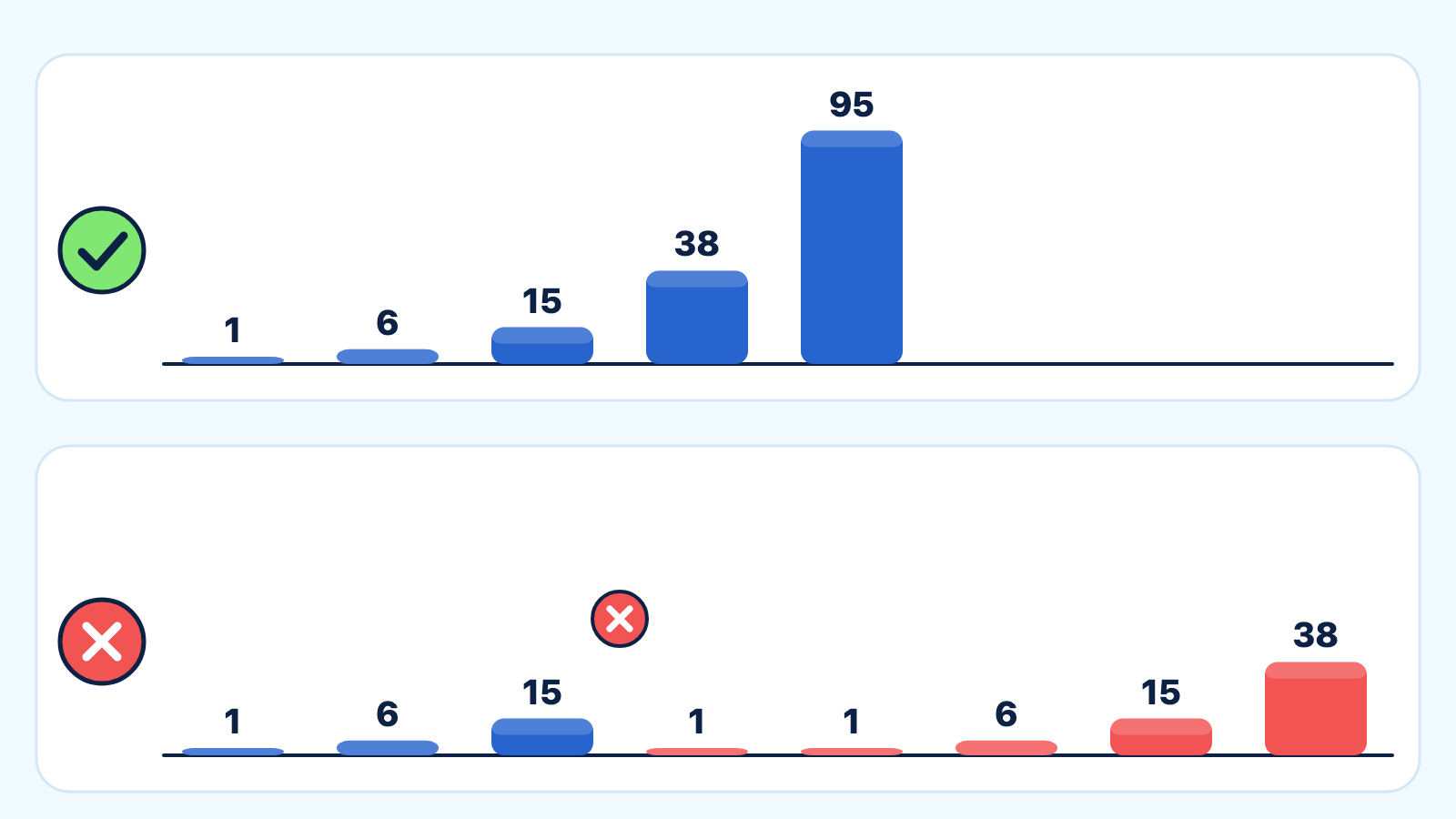
Days until the next review of one word. Top: answered right every time. Bottom: missed once, after which it comes back the next day and builds up again. Computed with Miaru's SM-2 settings (Wozniak, 1990), for answers rated Good.
What your answers change
Two kinds of answers move a word's schedule.
Questions
When a lesson or a review asks you about a word, by multiple choice, matching, listening or translating, a right answer counts as a solid "I knew it". The next gap gets longer. A wrong answer is a lapse.
Flashcards
When a word comes back as a flashcard, you flip it and say how well you knew it, with four buttons:
- Again ("Show soon"): you didn't know it. It counts as a lapse.
- Hard ("Tricky"): you got there, slowly. The next gap still grows, but the word's ease drops, so later gaps grow more slowly.
- Good ("Knew it"): the normal step forward.
- Easy ("Too easy"): the gap grows, and the word's ease rises, so it stays away even longer next time.
Be honest with these. A "Hard" on a word you half-remembered is useful information: it brings that word back sooner than a "Good" would. If you rate a card "Good" but then miss the same word in a question during that lesson, the miss wins. A word you couldn't recall shouldn't be pushed away just because you were feeling optimistic.
When you miss
Missing a word isn't failure. It is the system working. A lapse starts the word's run of reviews over: it comes back the next day, then the next day again, then six days later, and grows from there. Its ease doesn't drop with the miss, so once you have it back, the gaps grow as fast as before.
Where your reviews show up
You never have to go looking for what is due. It comes to you in two places.
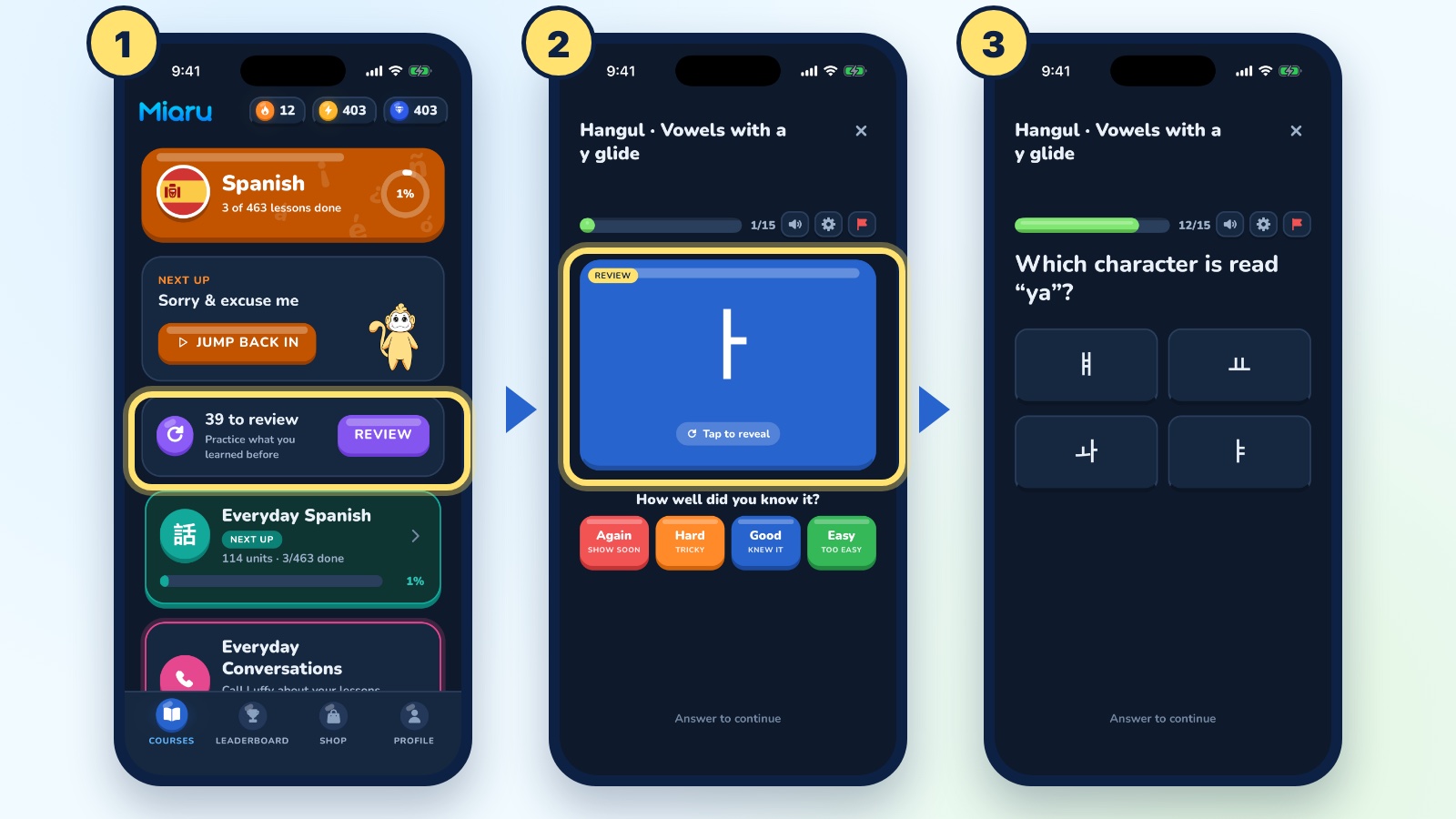
1. The course screen counts what is due. 2. A review card at the start of a lesson, rated with Again, Hard, Good or Easy. 3. Questions count too: a right answer pushes a character's next review further out.
In your lessons
Every lesson brings back up to 8 things that are due, oldest first. It never picks a word the lesson is teaching anyway. In a lesson on characters, such as kana, hangul or hanzi, due characters join the front of the lesson's first flashcard deck, each marked "Review". In a lesson built from everyday words and sentences, due words and sentences come first. They show up as flashcards and as questions mixed in with the new material. So even if you only ever do your next lesson, your old words keep coming back.
In a review round
When something is due, the course screen shows how many items are waiting, for example "39 to review", with a Review button. A round takes up to 15 due items from that course, oldest first, and asks each one as a real question:
- a character the way its own lessons ask it,
- a word as a multiple-choice question,
- a sentence as a translation.
Only an item no question fits comes as a flashcard you rate yourself. Because a round tests you rather than showing you the answer, it is retrieval practice and spaced repetition at the same time. Those are the two ideas from our retrieval practice post and the spaced repetition post, working together.
A finished round that reviews at least one due item counts toward your streak, just like a lesson. It also earns XP: one point for every three due items you answer right, up to 5 a round and 10 a day.
Free and Plus
On the free plan, you get one review round a day, across all your courses. Opening a round doesn't use it up. Only finishing one that reviews something does, so a stray tap costs you nothing. The next round opens at the start of your next day. The review cards inside lessons are there for everyone, every lesson. With Miaru Plus, you can run review rounds as often as you like.
If you keep forgetting a word you learned yesterday, you are in good company: Luffy does too, in this short video.
How to get the most out of it
1. Clear your reviews before new lessons
Due items are oldest first, and the oldest are the ones closest to slipping away. A quick round before your next lesson takes care of them while they are still easy to get back.
2. Rate honestly, especially "Hard"
"Good" on a word you barely got pushes it further away than it should go. "Hard" keeps it close, and that is what a shaky word needs.
3. Say it before you flip
On a flashcard, answer out loud or in your head before you tap to reveal. Recalling first is what makes it retrieval practice and not just rereading.
4. Don't fear the pile
Come back after a week away and you may find a lot waiting. That's fine. Each round takes at most 15 items, oldest first, and the rest wait their turn. A few days of short rounds clears it.
Try it in Miaru
Miaru brings this schedule to every course: Japanese, Spanish, Korean and Mandarin Chinese. Learn a few words today, and the app will bring them back tomorrow, next week and next month, just before you would forget them. That is also why a handful of well-kept words can take you so far, as we found in how many words you need to speak a language. On the cover, Luffy catches a word card coming home from its orbit, while AI, his sidekick, sends the next one back from further out.
References
- Cepeda, N. J., Pashler, H., Vul, E., Wixted, J. T., & Rohrer, D. (2006). Distributed practice in verbal recall tasks: A review and quantitative synthesis. Psychological Bulletin, 132(3), 354–380. https://doi.org/10.1037/0033-2909.132.3.354
- Cepeda, N. J., Vul, E., Rohrer, D., Wixted, J. T., & Pashler, H. (2008). Spacing effects in learning: A temporal ridgeline of optimal retention. Psychological Science, 19(11), 1095–1102. https://doi.org/10.1111/j.1467-9280.2008.02209.x
- Karpicke, J. D., & Roediger, H. L. (2008). The critical importance of retrieval for learning. Science, 319(5865), 966–968. https://doi.org/10.1126/science.1152408
- Wozniak, P. A. (1990). Application of a computer to improve the results obtained in working with the SuperMemo method. SuperMemo. https://www.supermemo.com/en/blog/application-of-a-computer-to-improve-the-results-obtained-in-working-with-the-supermemo-method
