
7 min read
How Many Words Do You Need to Speak a Language?
Native speakers know tens of thousands of words. You need far fewer to talk. What research on word coverage says, and which words to learn first.
- learning-science
- vocabulary
An average 20-year-old native speaker of American English knows about 42,000 dictionary words (lemmas), drawn from around 11,100 word families (Brysbaert et al., 2016). If that sounds like a mountain you have to climb before you can say anything, here is the good news: you don't need anywhere near that many to hold a conversation. A few thousand of the most frequent words do most of the work in everyday talk. The research behind that claim is about something called coverage. Once you understand it, you will know which words to learn first and when a book or show is ready for you.
Not all words are equal
Count the words in any conversation and a small group keeps showing up: the, and, I, you, go, want, good, today. Most words in the dictionary, on the other hand, turn up rarely. That imbalance is what lets learners get ahead fast.
Researchers measure it as coverage: the share of the running words in a text or a conversation that you already know. If you know 95 of every 100 words you hear, your coverage is 95%. They also tend to count word families rather than single forms. Paint, painted, painter and painting belong to one family, because once you know one, the others are easy to recognise.
What the research says
How much is "enough"?
In a well-known study by Hu and Nation, learners read a story in which some words had been swapped for made-up ones, so the researchers could control exactly how many were unknown. At 80% coverage, nobody understood the story adequately. Even at 95%, only a minority did. The researchers estimated that most readers need about 98% coverage, or one unknown word in fifty, to read a text without help, as Paul Nation summarises in his review (Nation, 2006).
A later study set two marks for reading: a minimal one at 95% coverage, which took about 4,000 to 5,000 word families, and an optimal one at 98%, which took about 8,000 (Laufer & Ravenhorst-Kalovski, 2010).
Listening needs fewer words than reading
Here is where it gets encouraging. Nation used large collections of real English to work out how many word families you need for different kinds of language. Novels and newspapers take 8,000 to 9,000 families to reach 98%. Everyday spoken English takes 6,000 to 7,000, because speech leans harder on the most common words (Nation, 2006).
And listening may not need 98% at all. When Hilde van Zeeland and Norbert Schmitt tested listening directly, most native and non-native listeners understood informal spoken stories adequately at 90% coverage, although the learners varied a lot at that level. At 95%, the learners understood relatively well and much more consistently. By that 95% yardstick, everyday listening takes 2,000 to 3,000 word families (van Zeeland & Schmitt, 2013).
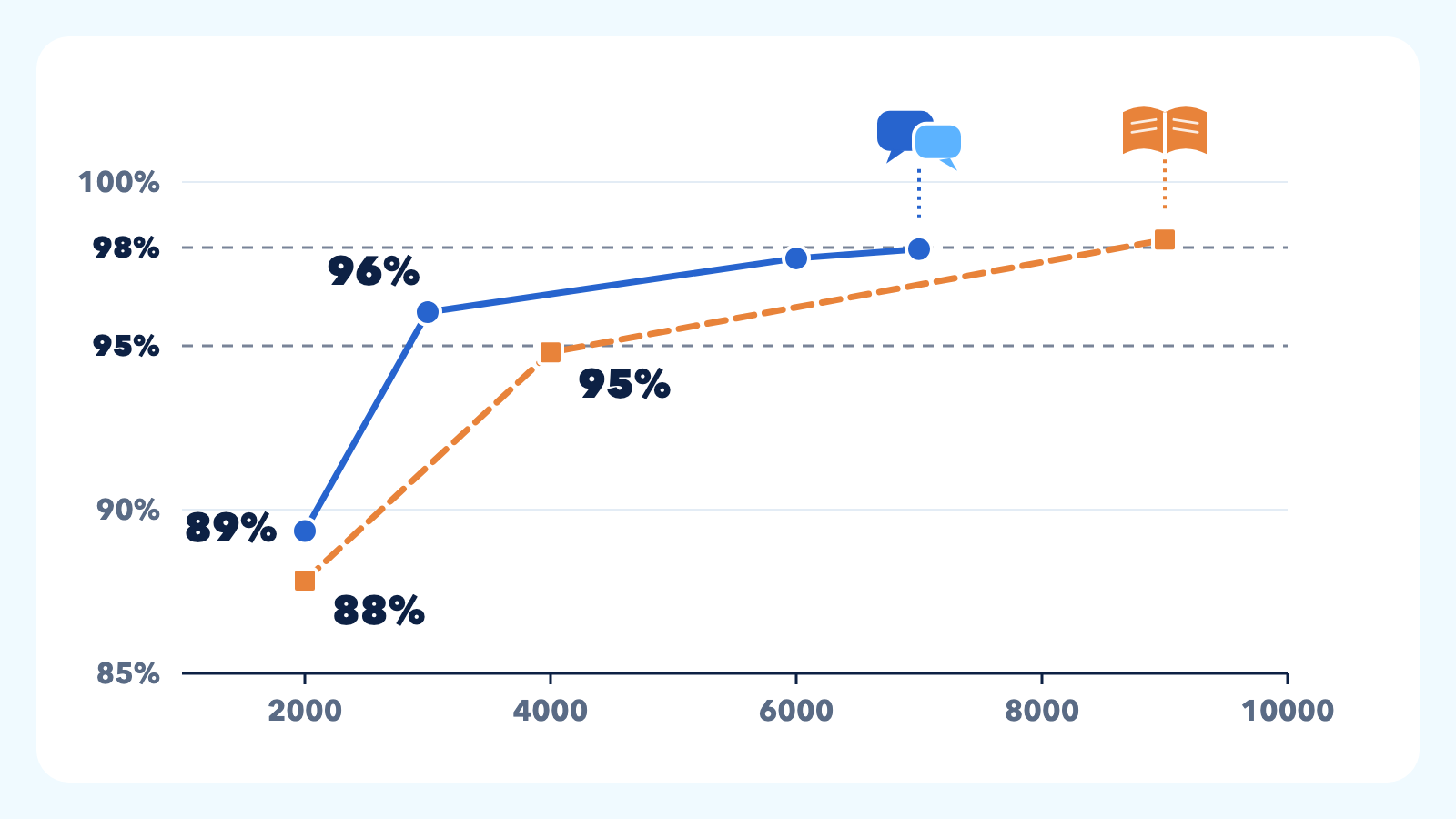
How much of a text you know as your vocabulary grows. The solid line is everyday conversation and the dashed line is novels. From 3,000 families on (4,000 for novels), names are counted as known. Data: Nation (2006), Table 13 and the novels combined.
The curve rises steeply and then flattens. The first 2,000 families already cover about 89% of conversation. The next thousand lifts it past 95%. After that, each extra thousand words adds less than one percentage point. Spanish shows the same shape: in Mark Davies's corpus, the 1,000 most frequent Spanish words covered about 88% of spoken Spanish, and the top 3,000 covered 94%. Each further thousand added less (Davies, 2005).
The thresholds are guides, not walls
It would be neat if understanding switched on at exactly 95% or 98%. The evidence says it doesn't. In a study of 661 readers from eight countries, comprehension rose steadily with the share of words known, with no sudden jump at any point (Schmitt, Jiang & Grabe, 2011). A 2025 replication of the original Hu and Nation study found no significant difference in comprehension between readers at 90%, 95% and 98% coverage. Readers who knew every word did better than those at 90% and 95%, and coverage explained a fairly small share of the differences between readers (Webb, Pellicer-Sánchez & Wang, 2025).
Some estimates are also higher than they first look. An older study suggested 2,000 word families gave nearly complete coverage of speech, but a modern corpus put 2,000 families below 95%, with around 5,000 individual words needed for about 96% (Adolphs & Schmitt, 2003).
So treat the numbers as a map, not a pass mark. Every word you add helps a little, and the most frequent words help the most.
How to use it today
1. Learn the most frequent words first
Your first target is the 2,000 to 3,000 most common word families of your language. That is enough for most of everyday conversation. Use a frequency list, or a course that starts with the words of daily life (greetings, food, time, places, plans) rather than with rare vocabulary like the names of fifteen fruits.
2. Learn families, not single forms
When you learn a word, learn how it changes. In Spanish, hablar (to speak) gives you hablo, hablas and habló. In Japanese, 食べる (taberu, to eat) gives you 食べます (tabemasu) and 食べた (tabeta). In Korean, 먹다 (meokda, to eat) gives you 먹어요 (meogeoyo) and 먹었어요 (meogeosseoyo). One family, many words you can now understand.
If you are learning Spanish from English, many words come half-learned already: curious and curioso, famous and famoso.
3. Use the one-in-twenty test
Before you commit to a book, an article or an episode, take a sample of about 100 words and count the ones you don't know. Around five unknown words (95%) means you can follow it with effort and a dictionary. Around two (98%) means you can relax and enjoy it. If you hit ten or more, put it aside for now and come back in a few months.
4. Learn the topic words before you start
Every story has words that keep coming back. Nation found that the children's film Shrek keeps repeating words like ogre and swamp. Count those few repeated words as known and you need about a thousand fewer word families to reach 98% coverage of the film (Nation, 2006). Before you watch or read something, look up its five or six key words. It is the cheapest coverage you will ever buy.
5. Keep the words you learn
A word you met once and forgot doesn't count toward your coverage. Review new words at growing intervals, as in spaced repetition, and test yourself instead of rereading, as in retrieval practice.
Try it in Miaru
Miaru lessons in Japanese, Spanish, Korean and Mandarin Chinese have you use new words straight away: matching them to their meanings, building sentences from a word bank, translating, and talking your way through short conversations. The words you learn come back for review in later lessons and in a daily review round, so they stay part of your vocabulary. On the cover, Luffy holds just a handful of cards in front of a whole wall of books, and that handful is the part to learn first.
References
- Adolphs, S., & Schmitt, N. (2003). Lexical coverage of spoken discourse. Applied Linguistics, 24(4), 425–438. https://doi.org/10.1093/applin/24.4.425
- Brysbaert, M., Stevens, M., Mandera, P., & Keuleers, E. (2016). How many words do we know? Practical estimates of vocabulary size dependent on word definition, the degree of language input and the participant's age. Frontiers in Psychology, 7, 1116. https://doi.org/10.3389/fpsyg.2016.01116
- Davies, M. (2005). Vocabulary range and text coverage: Insights from the forthcoming Routledge Frequency Dictionary of Spanish. In D. Eddington (Ed.), Selected Proceedings of the 7th Hispanic Linguistics Symposium (pp. 106–115). Cascadilla Proceedings Project. https://www.mark-davies.org/articles/davies_26.pdf
- Laufer, B., & Ravenhorst-Kalovski, G. C. (2010). Lexical threshold revisited: Lexical text coverage, learners' vocabulary size and reading comprehension. Reading in a Foreign Language, 22(1), 15–30. https://hdl.handle.net/10125/66648
- Nation, I. S. P. (2006). How large a vocabulary is needed for reading and listening? The Canadian Modern Language Review, 63(1), 59–82. https://doi.org/10.3138/cmlr.63.1.59
- Schmitt, N., Jiang, X., & Grabe, W. (2011). The percentage of words known in a text and reading comprehension. The Modern Language Journal, 95(1), 26–43. https://doi.org/10.1111/j.1540-4781.2011.01146.x
- van Zeeland, H., & Schmitt, N. (2013). Lexical coverage in L1 and L2 listening comprehension: The same or different from reading comprehension? Applied Linguistics, 34(4), 457–479. https://doi.org/10.1093/applin/ams074
- Webb, S., Pellicer-Sánchez, A., & Wang, A. (2025). Lexical coverage and reading comprehension revisited. Reading in a Foreign Language, 37(1), 1–21. https://doi.org/10.64152/10125/67517
