
8 min read
Hangul in a Day? How Miaru Teaches the Korean Alphabet
Why Hangul is one of the easiest alphabets to learn, what research says about learning to read it, and how Miaru's 34-lesson Hangul unit teaches it.
- miaru
- korean
- hangul
"You can learn the Korean alphabet in a day." It is one of the most repeated promises in language learning, and unlike most of them, it is not crazy. Hangul has only 24 basic letters, and they were designed, on purpose, to be learned. But reading Korean fluently takes more than knowing the letters, and the research on how people learn to read Hangul shows exactly where the extra work is.
This post explains what makes Hangul so learnable, what that research says, and how the Hangul unit in Miaru's Korean course takes you from your first vowel to reading real words.
An alphabet designed to be learned
Most writing systems grew slowly over centuries. Hangul was made on purpose. King Sejong's court records note that in 1443 the king made 28 letters, and that in 1446 the book that presented them, Hunminjeongeum, was completed. Korea celebrates Hangul Day on October 9 because of the date written in that book's preface (National Institute of Korean Language, n.d.-a). Modern Korean uses 24 basic letters (National Institute of Korean Language, n.d.-b).
Consonants drawn from the mouth
The five basic consonants are pictures of the speech organs that make them. ㄱ shows the back of the tongue touching the soft palate. ㄴ shows the tip of the tongue touching the ridge behind the upper teeth. ㅁ is the closed lips, ㅅ is a tooth, and ㅇ is the throat. The other consonants were built from these five. A sound made in the same place but a little stronger gets one more stroke: ㄴ becomes ㄷ, ㅁ becomes ㅂ, ㅅ becomes ㅈ, ㅇ becomes ㅎ. Add a stroke to a plain consonant and you get its aspirated partner, with a puff of air (ㄱ to ㅋ). Write the plain letter twice and you get its tense partner (ㄱ to ㄲ). So the shapes tell you how the sounds are related (National Institute of Korean Language, n.d.-c).
Vowels from heaven, earth and a person
The vowels started from three symbols: a round dot for heaven, a flat line for the earth, and an upright line for a person standing. The other vowels combine them. Put the dot to the right of the upright line and you get ㅏ; put it above the flat line and you get ㅗ, below it and you get ㅜ (National Institute of Korean Language, n.d.-d). In today's letters the dot is written as a short stroke, but the logic is still there: once you know where the short stroke points, you can tell most vowels apart.
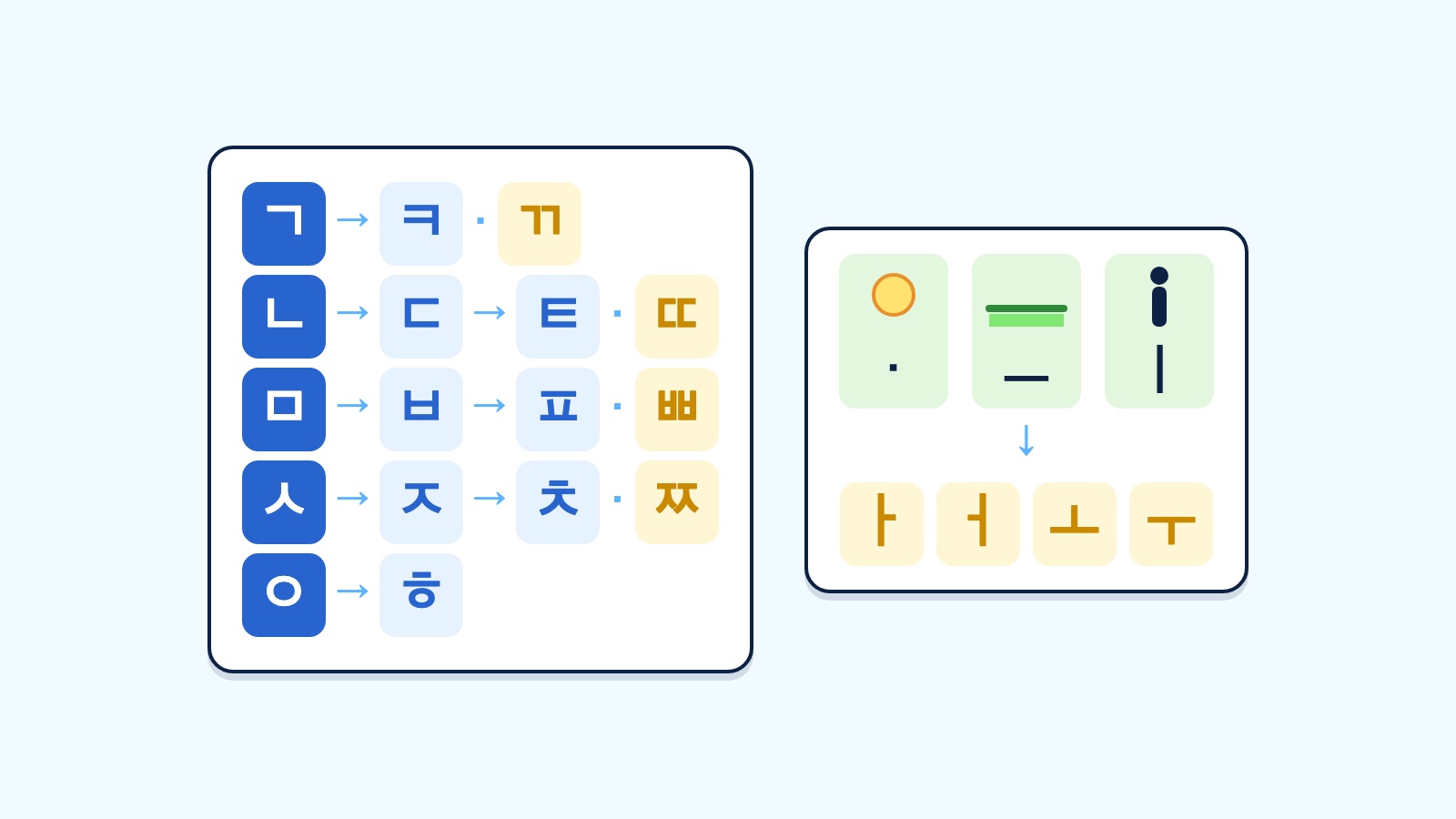
How the letters were designed: added strokes turn the five basic consonants (dark blue) into stronger and aspirated ones, and doubling a plain letter makes a tense one (yellow). The vowels grew out of heaven, earth and a person (National Institute of Korean Language, n.d.-c, n.d.-d).
Letters stacked into syllables
The second clever idea is that the letters are not written in a row like English. They are stacked into square blocks, one block per syllable: a consonant, a vowel, and sometimes a final consonant underneath. Whether the vowel sits to the right or below depends on its shape: tall vowels like ㅏ go to the right, flat vowels like ㅗ go underneath. Hye K. Pae describes Korean as alphabetic in principle, since each letter stands for a sound, but organized in syllables when you see and read it. Pae argues that Hangul meets the two marks of an optimal writing system: easy for beginners to acquire and efficient for skilled readers (Pae, 2011).
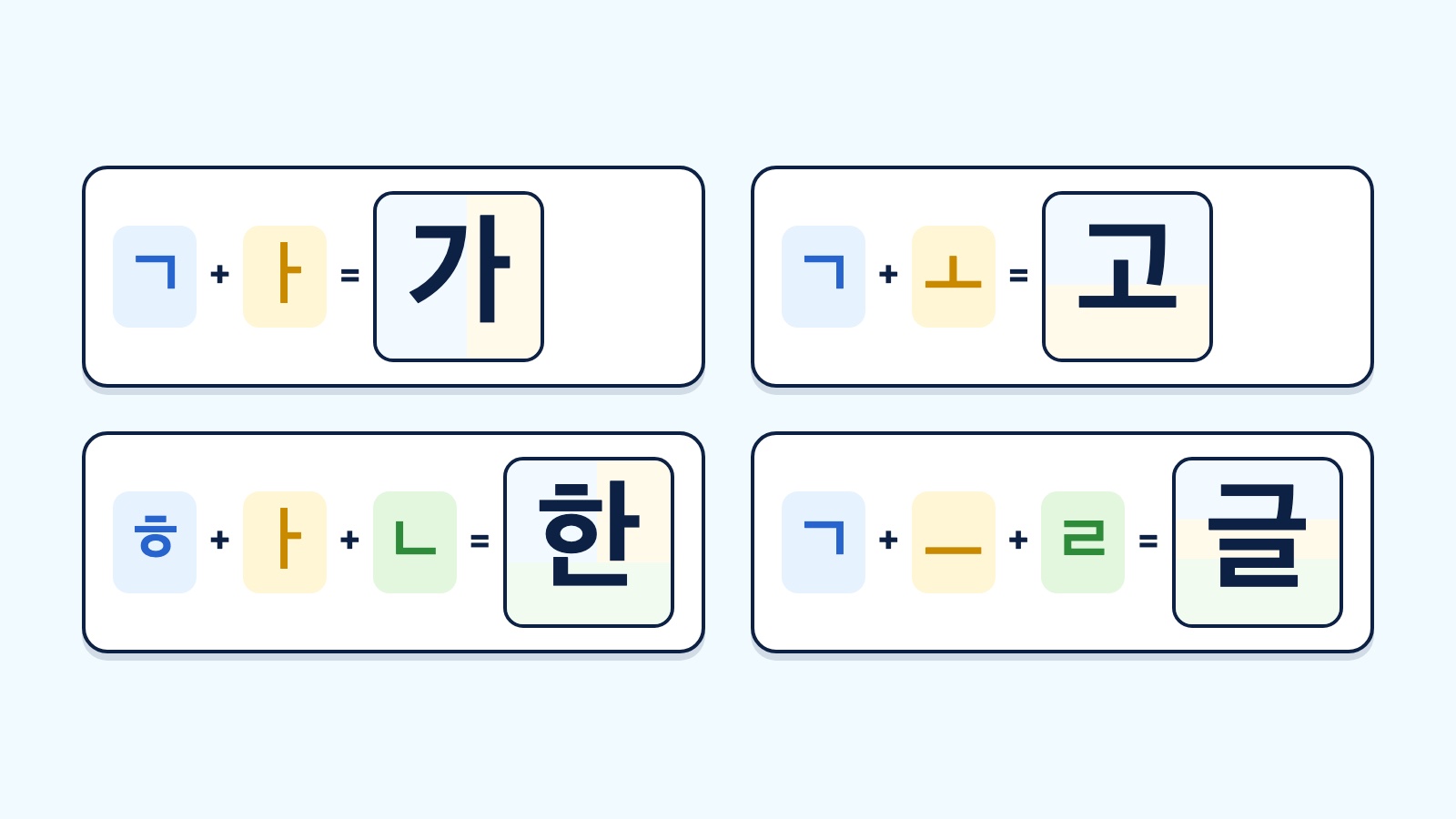
One block, one syllable: the first consonant (blue), the vowel (yellow) and an optional final consonant (green). The last two blocks spell 한글, Hangul.
What the research says about learning to read it
If the letters are that logical, why doesn't everyone read Korean after a day? Two studies help explain.
Jeung-Ryeul Cho and Catherine McBride-Chang tested 100 Korean kindergartners and 100 second graders on a range of reading-related skills. The skills that uniquely predicted how well children read Hangul words were syllable awareness and phoneme awareness: hearing a word as syllables, and hearing the individual sounds inside them. The authors point out that Hangul asks readers to be sensitive to both levels at once, the letters and the blocks (Cho & McBride-Chang, 2005). For a learner, that means knowing each letter is only half the job; you also need to see the block as one syllable.
A later study compared 94 five-year-old Korean children with 41 Hong Kong Chinese college students learning Korean as a foreign language. In both groups, spelling was less accurate for syllables whose spelling and sound don't line up in a consistent way, which researchers call phonologically inconsistent syllables (Cho & McBride, 2022). That is the honest catch behind "Hangul in a day". In Korean, many of those mismatches come from sound changes: a final consonant can sound different when the next block starts with a vowel or a nasal. The letters are the quick part; reading across blocks is what takes practice.
How the Hangul unit in Miaru works
The Korean course in Miaru opens with a Hangul unit of 34 short lessons. It follows the same path as the design above:
- Vowels first. The vertical vowels, then the horizontal ones, then the vowels with a y glide.
- Consonants by family. The first consonants, more basic consonants, then the aspirated and tense ones, so you meet each letter next to its partners.
- Building blocks. Syllables with the silent ㅇ in front, blocks with the vowel to the right, blocks with the vowel underneath, and blocks with combined vowels.
- Final consonants. The letters at the bottom of a block, and why several spellings can end in the same sound.
- Real words and sound changes. How a final consonant slides onto the next vowel, how sounds change when they meet, and a last checkpoint where you read, rebuild and explain a set of everyday words.
Each lesson starts with a short read that points out what to look for, such as which way a short stroke points or why a block is laid out the way it is. Then each new letter or block gets a flashcard: you try to recall it, tap to reveal, and rate how well you knew it with Again, Hard, Good or Easy. A matching board pairs letters with their sounds, and the questions go both ways: from a letter to its reading, and from a reading back to the letter, each with four look-alike choices. Letters from earlier lessons come back as reviews, so the first vowels you learned keep showing up while you learn new ones.
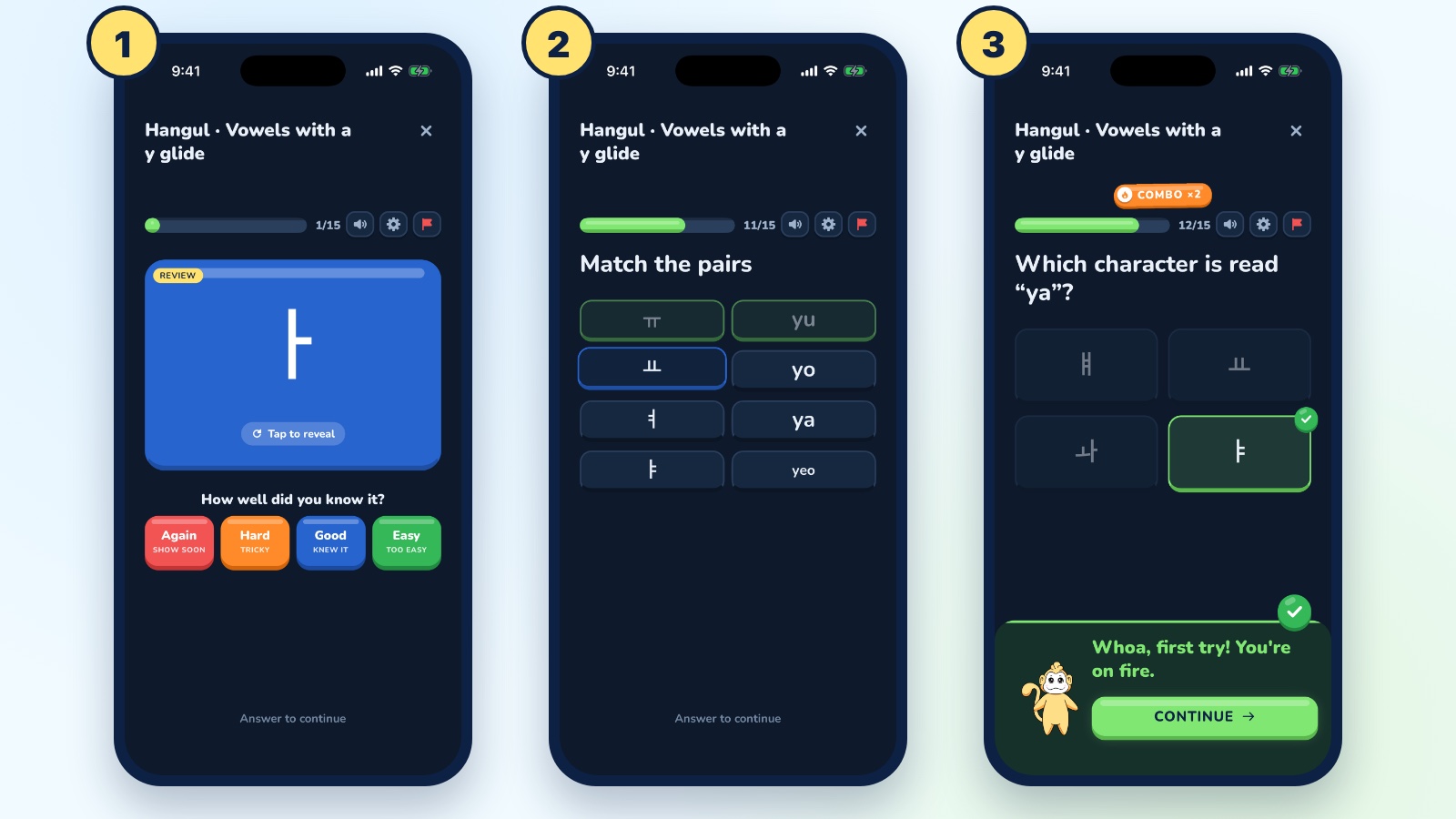
A Hangul lesson in Miaru: (1) a flashcard for a vowel you learned earlier, back for review; (2) matching vowels with their sounds; (3) picking ㅑ from four look-alikes.
How to learn Hangul fast (and well)
- Learn the system, not a list. Look for the extra stroke and the doubled letter. Once you know ㄱ, you are most of the way to ㅋ and ㄲ.
- Read by the short stroke. For the vowels, ask where the short stroke points: right, left, up or down. That one question separates ㅏ, ㅓ, ㅗ and ㅜ.
- Think in blocks. Read a block as one syllable, not as three letters. The research above says both levels matter.
- Test yourself both ways. Read a letter and say its sound; then hear or see a sound and find the letter. Recalling it beats looking at a chart, as our post on how every exercise in a lesson makes you recall explains.
- Give the sound changes time. Knowing every letter is not the same as reading smoothly across blocks. Expect the sound changes to take longer, and keep reading real words.
Try it in Miaru
Open the Korean course in Miaru and start with the first Hangul lesson, the three vertical vowels. The letters you learn come back later at the right time; here is how Miaru brings your words back. On the cover, Luffy is building a little wall of letter blocks on a flat meadow at sunrise, and the three shapes the vowels came from are hiding in the picture: the round sun for heaven, the flat horizon for the earth, and Luffy himself, standing tall, for a person.
References
- Cho, J.-R., & McBride, C. (2022). Different cognitive correlates of early learning of spelling of different target types in Korean Hangul among first language children and adult foreign language learners. Journal of Learning Disabilities, 55(2), 138–153. https://doi.org/10.1177/0022219420978231
- Cho, J.-R., & McBride-Chang, C. (2005). Correlates of Korean Hangul acquisition among kindergartners and second graders. Scientific Studies of Reading, 9(1), 3–16. https://doi.org/10.1207/s1532799xssr0901_2
- National Institute of Korean Language. (n.d.-a). 한글의 창제 [The creation of Hangul]. In 알고 싶은 한글. https://www.korean.go.kr/hangeul/origin/001.html
- National Institute of Korean Language. (n.d.-b). 한글의 자모 [The letters of Hangul]. In 알고 싶은 한글. https://www.korean.go.kr/hangeul/principle/001.html
- National Institute of Korean Language. (n.d.-c). 자음 글자의 원리 [How the consonant letters were made]. In 알고 싶은 한글. https://www.korean.go.kr/hangeul/principle/002.html
- National Institute of Korean Language. (n.d.-d). 모음 글자의 원리 [How the vowel letters were made]. In 알고 싶은 한글. https://www.korean.go.kr/hangeul/principle/003.html
- Pae, H. K. (2011). Is Korean a syllabic alphabet or an alphabetic syllabary. Writing Systems Research, 3(2), 103–115. https://doi.org/10.1093/wsr/wsr002
