
6 min read
Inside a Miaru Lesson: Why Every Exercise Makes You Recall
Flashcards, look-alike choices, match boards and sentence tiles: what each Miaru exercise asks of you, and the memory research behind it.
- miaru
- retrieval-practice
- learning-science
Open a Miaru lesson and it can feel like a game: tap a card, pick a character, match the pairs, build a sentence. But almost every screen is doing the same job, and it is not "show you the word again". It is asking you to pull the word out of your own memory. This post walks through each exercise in a lesson, what it asks of you, and the research behind it.
If you read our post on retrieval practice, you know the headline: testing yourself beats rereading. Here is what that looks like when it is built into an app.
The research in one minute
- Practice tests beat restudying. A meta-analysis of the testing effect found that practice tests were more beneficial for learning than restudying and every other comparison condition (Adesope, Trevisan & Sundararajan, 2017).
- Producing an answer beats reading it. Across 86 studies, people remembered material they generated themselves better than material they simply read, by about 0.4 of a standard deviation (Bertsch et al., 2007).
- Multiple choice can be real retrieval. When the wrong options are plausible, multiple-choice questions make you recall why the right answer is right and why the others are wrong, and they even helped people later recall facts about the wrong options (Little et al., 2012).
- Feedback makes it safer. Multiple choice can teach you a wrong option by accident. Showing feedback, right away or later, raised correct answers and cut those intrusions on a later test (Butler & Roediger, 2008).
The exercises, one by one
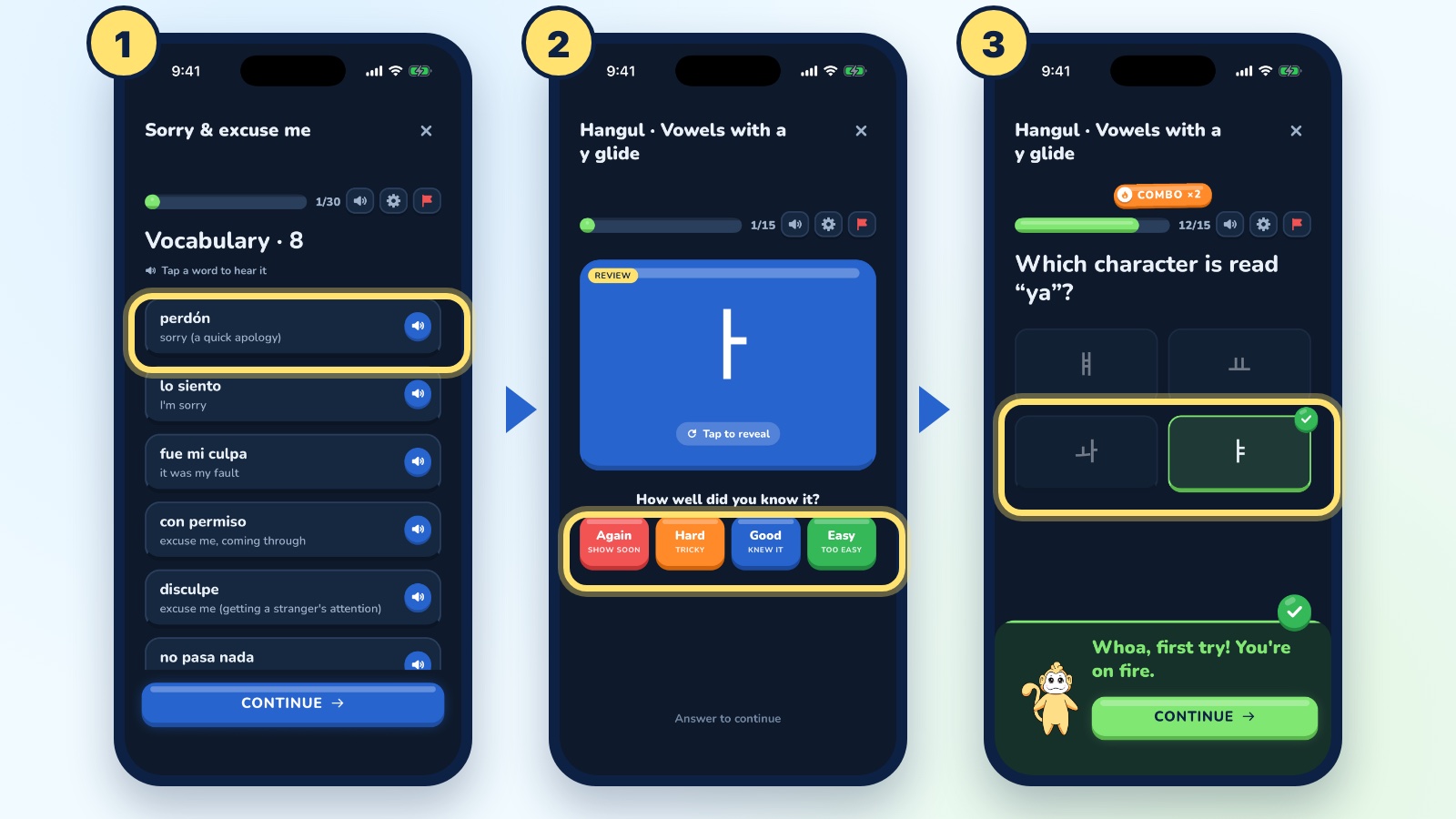
Real screens from Miaru 1.4.0: (1) new words, tap to hear them; (2) a flashcard you rate yourself; (3) a multiple-choice question answered on the first try.
1. New words: meet them, hear them
A lesson starts by showing you its new words. Each row has the word and its meaning, and you tap a word to hear it. This is the only time the lesson simply shows you something. Everything after it asks you to recall.
2. Flashcards: say it, then rate yourself
A flashcard shows one side. Tap to reveal the other, then answer "How well did you know it?" with Again, Hard, Good or Easy. Your rating is not decoration: it feeds the review schedule that decides when that word comes back. Again brings it back tomorrow, and Easy pushes it furthest out (more on that in how Miaru brings your words back). The trick is to say the answer in your head before you tap, so the reveal checks your memory rather than replacing it.
3. Multiple choice: pick from look-alikes
Questions like "Which character is read ya?" give you four options, and in a writing system like Hangul the options look alike on purpose. That is what makes it real retrieval: you have to tell ㅑ from ㅕ, ㅛ and ㅒ, not just spot a familiar shape. Some questions play a sound and ask what it means; others let you hear each choice. Get several right in a row and a combo counter climbs.
4. Match the pairs
A match board gives you a column of words or characters and a column of meanings or readings. Tap one on each side to pair them. A wrong pair just flashes, so you try again, and tapping a tile plays its sound.
5. Translate: build the sentence
A translation exercise plays a sentence and asks you to rebuild it from word tiles in the right order, then tap Check. Putting the words in order yourself is a small act of generation: you are producing the sentence, not recognizing it.
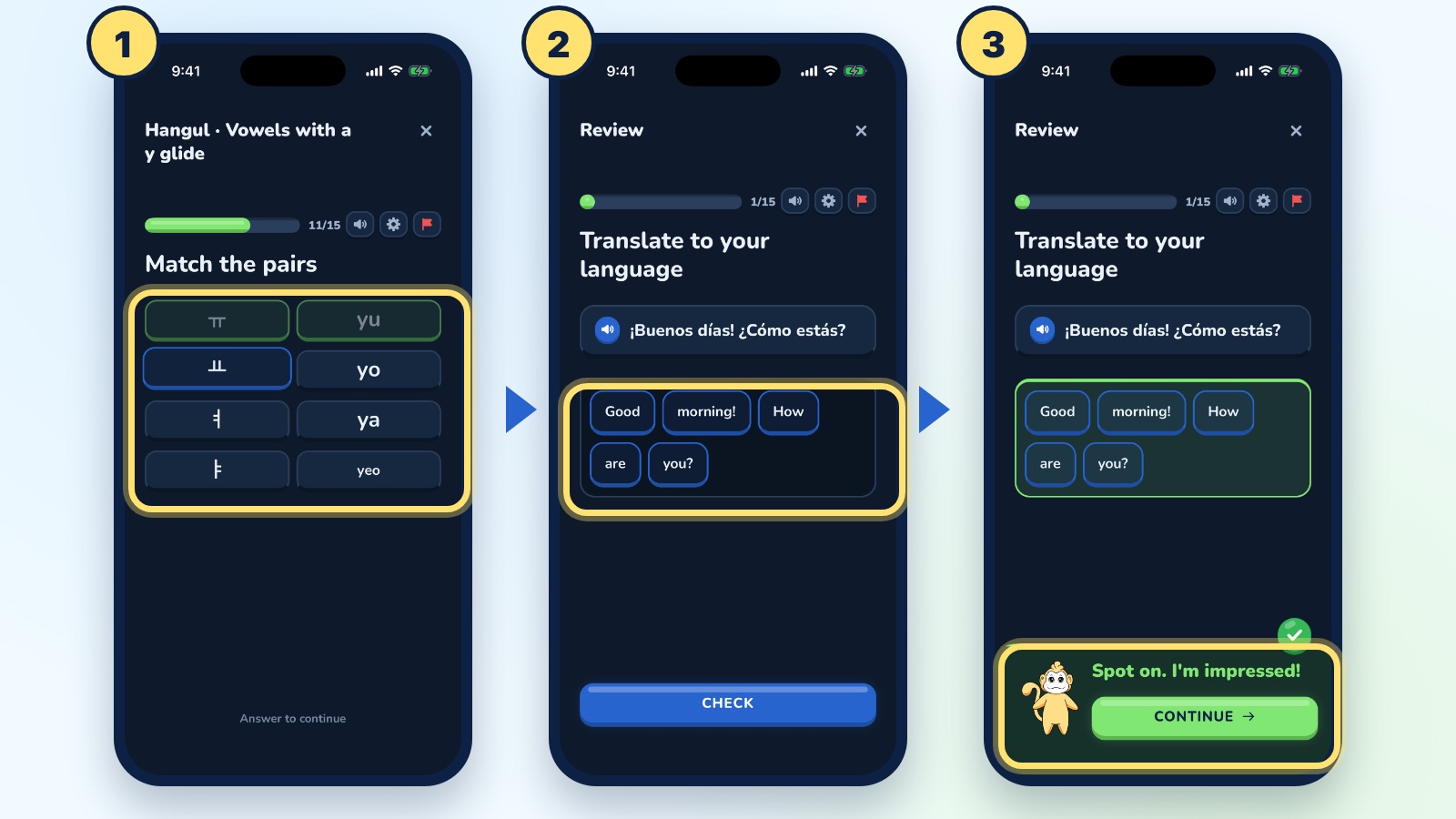
(1) Matching Hangul vowels to their sounds; (2) building a translation from tiles; (3) the feedback after a right answer.
6. Feedback after every answer
After each answer, a sheet slides up with a green check or an amber cross and a line from Luffy. If you missed a multiple-choice question or a translation, it shows you the correct answer, which is exactly the feedback that keeps a wrong option from sticking. There are no hearts or lives: a mistake never ends your lesson. It only resets your combo.
7. Your reviews, dealt in
A lesson can also deal in words from earlier lessons that are due for review, so old words keep coming back while you learn new ones. That is spacing and retrieval working together.
8. The finish line
At the end you get a score: the share of questions you got right. Score 90 or more and Luffy throws a "Perfect lesson!" celebration. You earn 1 XP for finishing plus 1 XP per correct answer, and the same number of sapphires. Replaying a lesson only earns the XP above your best run.
Why so many kinds of exercise?
The same word can be pulled out of memory from different directions, and each direction is a separate skill. A flashcard might show you the word and ask for its meaning, or the other way round. A multiple-choice question might start from a sound and ask for the character. A match board makes you link a whole set at once. A translation makes you put words in the right order. Meeting one word through several of these means you can recognize it when you read it, pick it out when you hear it, and use it in a sentence when you need it.
It is also why a lesson rarely lets you coast. As soon as an exercise starts to feel automatic, the next one asks for the same knowledge in a new way. That bit of extra effort is the point: the generation and testing studies above all compare effortful recall with the easy option of looking again, and the effortful option wins.
How to get more out of every lesson
- Answer before you look. On a multiple-choice question, try to recall the answer before reading the options. Then the options only confirm it.
- Rate flashcards honestly. Pressing Easy on a word you barely knew sends it away for too long. Hard and Again keep it close.
- Read the correct answer after a miss. That two-second look is the feedback that fixes the mistake.
- Tap the sound. Hearing each word as you see it ties the spelling to the pronunciation. Then say it out loud too.
- Don't fear the cross. A wrong answer followed by feedback is still learning, and in Miaru it costs nothing but your combo.
Try it in Miaru
Every course in Miaru is built from these exercises. On the free plan you can open 5 lessons, then one new lesson a day, plus one more each day for 50 sapphires; Miaru Plus unlocks every lesson and adds calls where you practice speaking out loud. On the cover, Luffy is at the memory gym, lifting a dumbbell made of word tiles while Ai cheers him on.
References
- Adesope, O. O., Trevisan, D. A., & Sundararajan, N. (2017). Rethinking the use of tests: A meta-analysis of practice testing. Review of Educational Research, 87(3), 659–701. https://doi.org/10.3102/0034654316689306
- Bertsch, S., Pesta, B. J., Wiscott, R., & McDaniel, M. A. (2007). The generation effect: A meta-analytic review. Memory & Cognition, 35(2), 201–210. https://doi.org/10.3758/BF03193441
- Butler, A. C., & Roediger, H. L. (2008). Feedback enhances the positive effects and reduces the negative effects of multiple-choice testing. Memory & Cognition, 36(3), 604–616. https://doi.org/10.3758/MC.36.3.604
- Little, J. L., Bjork, E. L., Bjork, R. A., & Angello, G. (2012). Multiple-choice tests exonerated, at least of some charges: Fostering test-induced learning and avoiding test-induced forgetting. Psychological Science, 23(11), 1337–1344. https://doi.org/10.1177/0956797612443370
