
6 min read
Interleaving vs. Blocking: Why Mixed Practice Sticks
Practicing one thing at a time feels best, but mixing often wins. What research says about interleaving, and when it helps language learners.
- learning-science
- interleaving
- grammar
Here is a study habit that feels right and often is not: practice one thing until you have it, then move on to the next. Ten past-tense verbs, then ten more of the same kind. A page of one grammar point, then a page of the next. Researchers call this blocked practice. The alternative is to shuffle the different kinds together, so you never know which one is coming next. That is interleaved practice, and it usually feels slower, messier and worse.
In many studies it is also better. But not always, and the exceptions matter for language learners. Here is what the research says, and how to use it.
What the research says
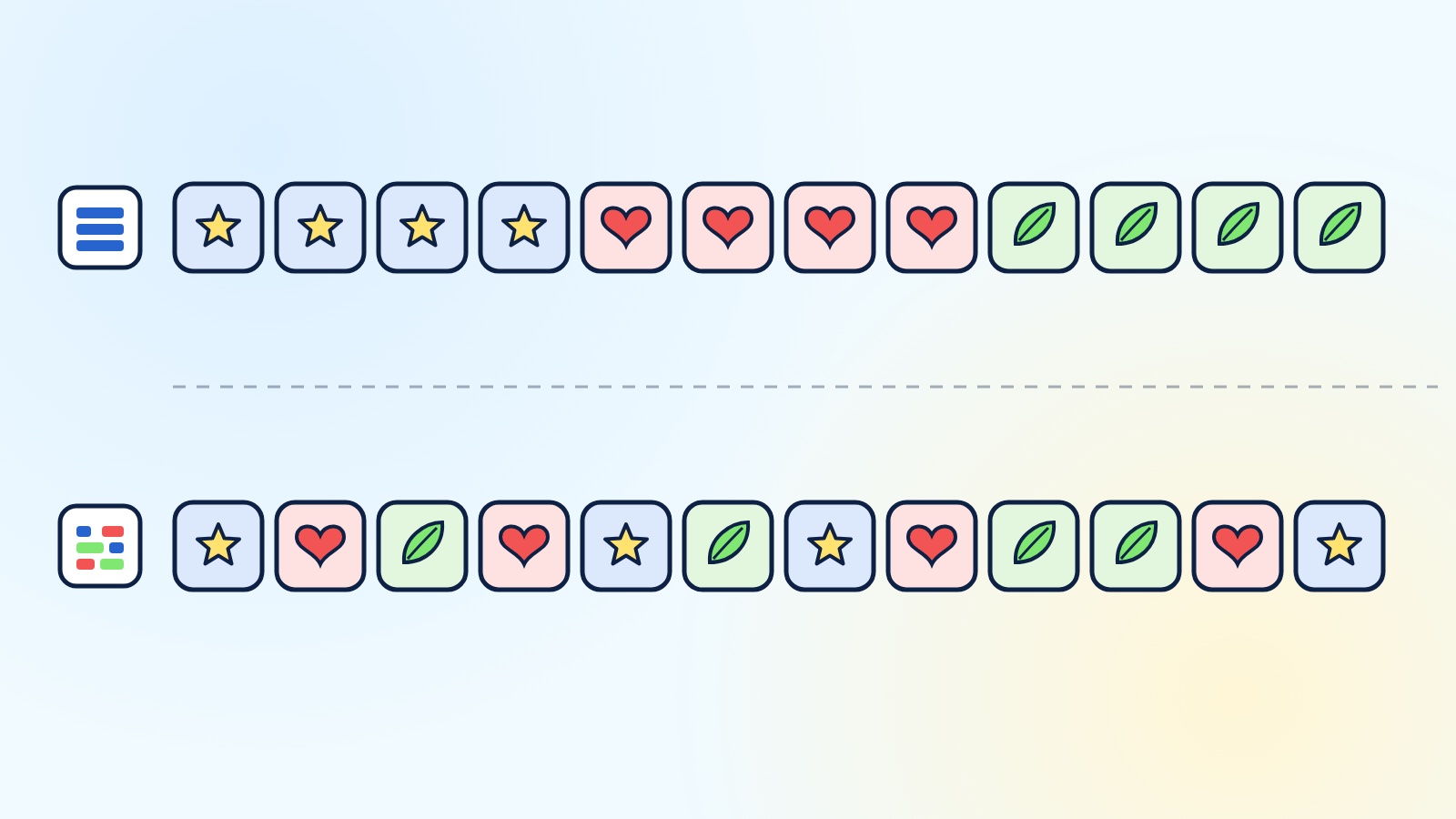
Blocked practice (top) does all of one kind before the next. Interleaved practice (bottom) uses the same items, mixed.
Mixing feels worse, even when it works better
Nate Kornell and Robert Bjork asked people to learn the styles of different painters from examples. Some artists' paintings were shown one after another; others were mixed in among other artists. When people then had to name the artist of new paintings they had never seen, mixing came out ahead. Yet participants rated the one-after-another order as more effective, even after their own test results had shown the opposite (Kornell & Bjork, 2008). Blocked practice feels fluent. That feeling is not a reliable guide to what sticks.
In a real classroom, the gap grew with time
Doug Rohrer and colleagues gave 126 seventh-graders the same math problems over three months, arranged either in blocks or mixed. On a surprise test a day after the final review, the mixed group scored higher, and a month later the advantage was even bigger (Cohen's d of 0.42, then 0.79). The authors point out why: when every problem on a page uses the same method, you know the method before you read the problem. Mixing forces you to work out which method a problem needs, just as a real test or a real conversation does (Rohrer, Dedrick & Stershic, 2015).
It works for grammar, too
Two studies tested interleaving on language learning directly:
- Spanish past tenses. Adults learned to conjugate verbs in the preterite and the imperfect, the two Spanish past tenses learners famously mix up. When all the training happened in one session, interleaving gave no advantage. When it was spread over two weekly sessions, the group that practiced both tenses mixed together did substantially better on a test a week later (Pan et al., 2019).
- English grammar. 115 Japanese learners practiced five English grammar structures either blocked, interleaved, or blocked first and then interleaved. The interleaved group made the most mistakes during practice, but did best a week later. Learners who knew less at the start gained the most from mixing (Nakata & Suzuki, 2019).
But not for everything
A meta-analysis of 59 studies found a moderate overall benefit of interleaving (Hedges' g = 0.42). It was largest for paintings and other visual material (0.67) and smaller for math (0.34). For studies based on words, the result flipped: blocking did better (−0.39). Interleaving helped most when the categories were similar to each other and the examples within a category varied, and when the material was complex (Brunmair & Richter, 2019).
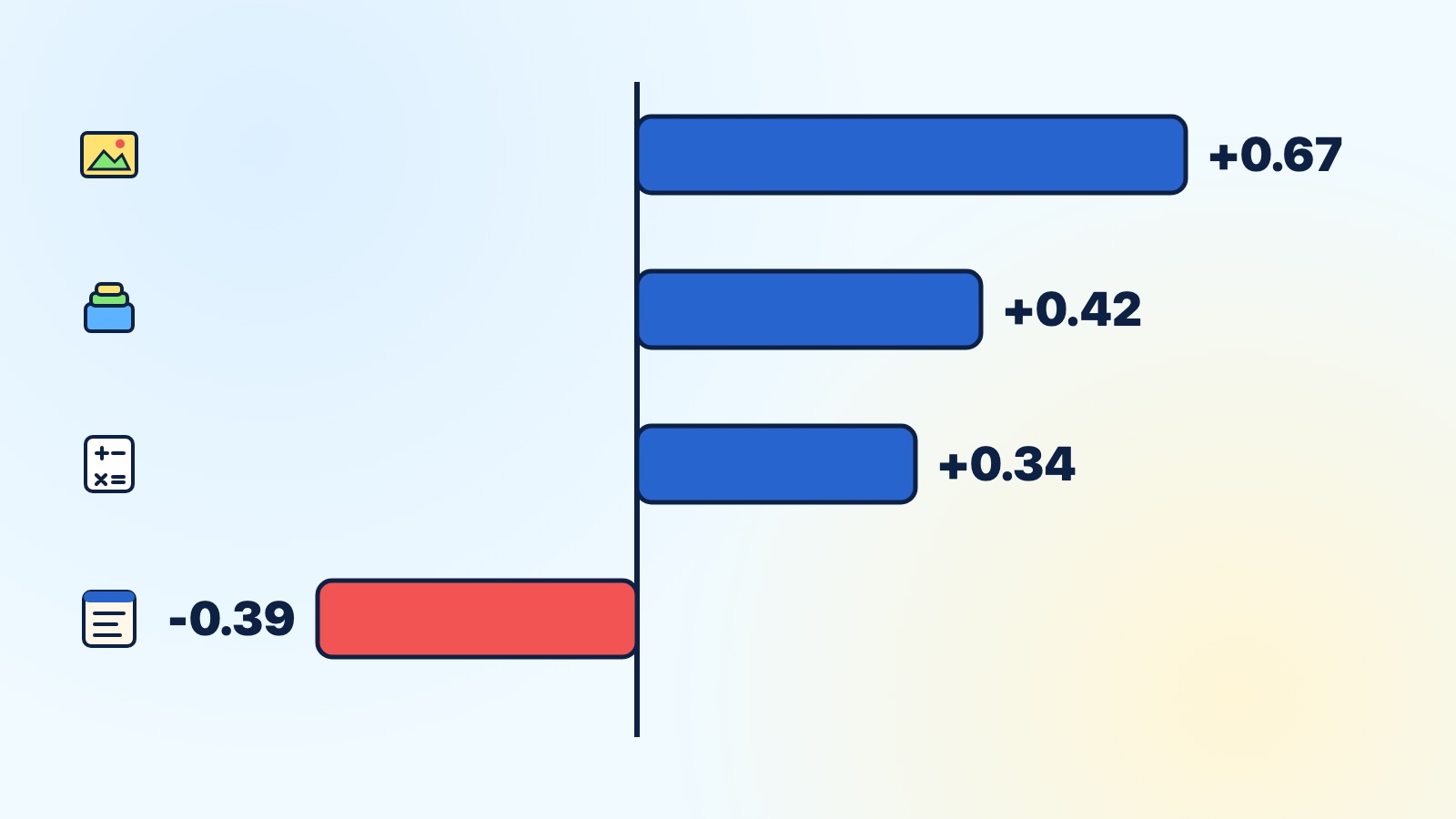
The interleaving effect by type of material, from a meta-analysis of 59 studies. Positive values favor mixing; the negative value for words favors blocking (Brunmair & Richter, 2019).
The lesson is not "always mix". It is: mix when the hard part is telling things apart.
Why mixing helps
In blocked practice, the order of the exercises gives the answer away. If the last nine sentences needed the preterite, the tenth probably does too, so you never have to decide. Interleaved practice takes that crutch away. Every item makes you ask "which one is this?", and that is the exact question a real conversation asks. It also puts the confusable things side by side, so you notice the differences between them.
This is a different idea from spacing, though the two often travel together. Spaced repetition is about when you come back to something. Interleaving is about what else sits next to it when you do.
How to use it today
- Mix the things you confuse. Spanish preterite and imperfect (ayer comí paella vs de niño comía paella los domingos). Japanese は and が. Look-alike characters like Korean ㅓ and ㅕ, or Chinese 人 and 入. Practice them shuffled, not in separate sets.
- Meet brand-new words in focused sets first. For simple word learning, the evidence leans toward blocking. Learn a small group, then mix it with older words once you know them a little.
- Mix across days, not only within one sitting. In the Spanish study, interleaving only paid off when practice was spread over sessions.
- Expect more mistakes, and keep going. Mixed practice produces more errors while you train. That is the effort doing its work, not a sign it is failing.
- Don't trust how it feels. If a set feels easy because every item is the same kind, shuffle it.
A week of mixed practice
Say you are learning the two Spanish past tenses. Here is one way to put the research together:
- Day 1: learn how the preterite is formed and practice it on its own, in a short focused set. Brand-new material is easier to absorb in a block.
- Day 2: do the same for the imperfect.
- Day 3 onward: stop practicing them separately. Every set now mixes both tenses, so each sentence makes you decide: a finished action (ayer comí paella) or a habit and background (de niño comía paella los domingos)?
- Each new session: add a few older items too, such as present-tense verbs or vocabulary from last week, so the mix keeps growing.
Expect day 3 to feel harder than day 2, and to get more wrong. That is the point where the learning that lasts begins. The same pattern works for は and が in Japanese or for any pair of grammar points you keep mixing up: learn each one, then never practice them apart again.
Try it in Miaru
In a Miaru lesson, new words come first in a focused set, then the practice mixes match boards, multiple-choice questions and translations in shuffled order (see inside a Miaru lesson). Words from earlier lessons that are due for review get dealt in alongside the new ones, so old and new are always mixed (more in how Miaru brings your words back). On the cover, Luffy is at a conveyor-belt sushi bar where no two plates in a row are alike.
References
- Brunmair, M., & Richter, T. (2019). Similarity matters: A meta-analysis of interleaved learning and its moderators. Psychological Bulletin, 145(11), 1029–1052. https://doi.org/10.1037/bul0000209
- Kornell, N., & Bjork, R. A. (2008). Learning concepts and categories: Is spacing the "enemy of induction"? Psychological Science, 19(6), 585–592. https://doi.org/10.1111/j.1467-9280.2008.02127.x
- Nakata, T., & Suzuki, Y. (2019). Mixing grammar exercises facilitates long-term retention: Effects of blocking, interleaving, and increasing practice. The Modern Language Journal, 103(3), 629–647. https://doi.org/10.1111/modl.12581
- Pan, S. C., Tajran, J., Lovelett, J., Osuna, J., & Rickard, T. C. (2019). Does interleaved practice enhance foreign language learning? The effects of training schedule on Spanish verb conjugation skills. Journal of Educational Psychology, 111(7), 1172–1188. https://doi.org/10.1037/edu0000336
- Rohrer, D., Dedrick, R. F., & Stershic, S. (2015). Interleaved practice improves mathematics learning. Journal of Educational Psychology, 107(3), 900–908. https://doi.org/10.1037/edu0000001
