
8 min read
Kanji Mnemonics: Do Memory Stories Really Work?
Breaking kanji into parts and tying them together with a story helps you remember them. What six studies found, the catch, and how to use it.
- learning-science
- japanese
- kanji
Look closely at the kanji 休, which means rest. On the left is 亻, a squeezed form of 人, person. On the right is 木, tree. A person leaning against a tree: taking a rest. Once you have seen it, it is hard to unsee, and that is the whole idea behind kanji mnemonics.
Japanese uses thousands of kanji, and to a beginner they can look like a wall of random lines. Memory tricks promise a way over the wall: break each character into parts, give the parts meanings, and tie them together with a little story. Do they actually work, or do they just feel clever? Here is what the research says, where it urges caution, and how to use mnemonics without letting them get in your way.
What the research says
Memory links can raise recall by more than half
The modern study of language mnemonics starts with Richard Atkinson and Michael Raugh at Stanford. They taught 52 undergraduates, none of whom had studied Russian, 120 Russian words over three days. One group used the keyword method: for each Russian word they were given an English word that sounds like part of it, and pictured that keyword interacting with the meaning. The Russian zvonók (bell) sounds a little like "oak", so you might picture an oak tree hung with little bells for acorns. The other group learned however they liked. On the main final test, the keyword group got 72% right, against 46% for the control group (Atkinson & Raugh, 1975).
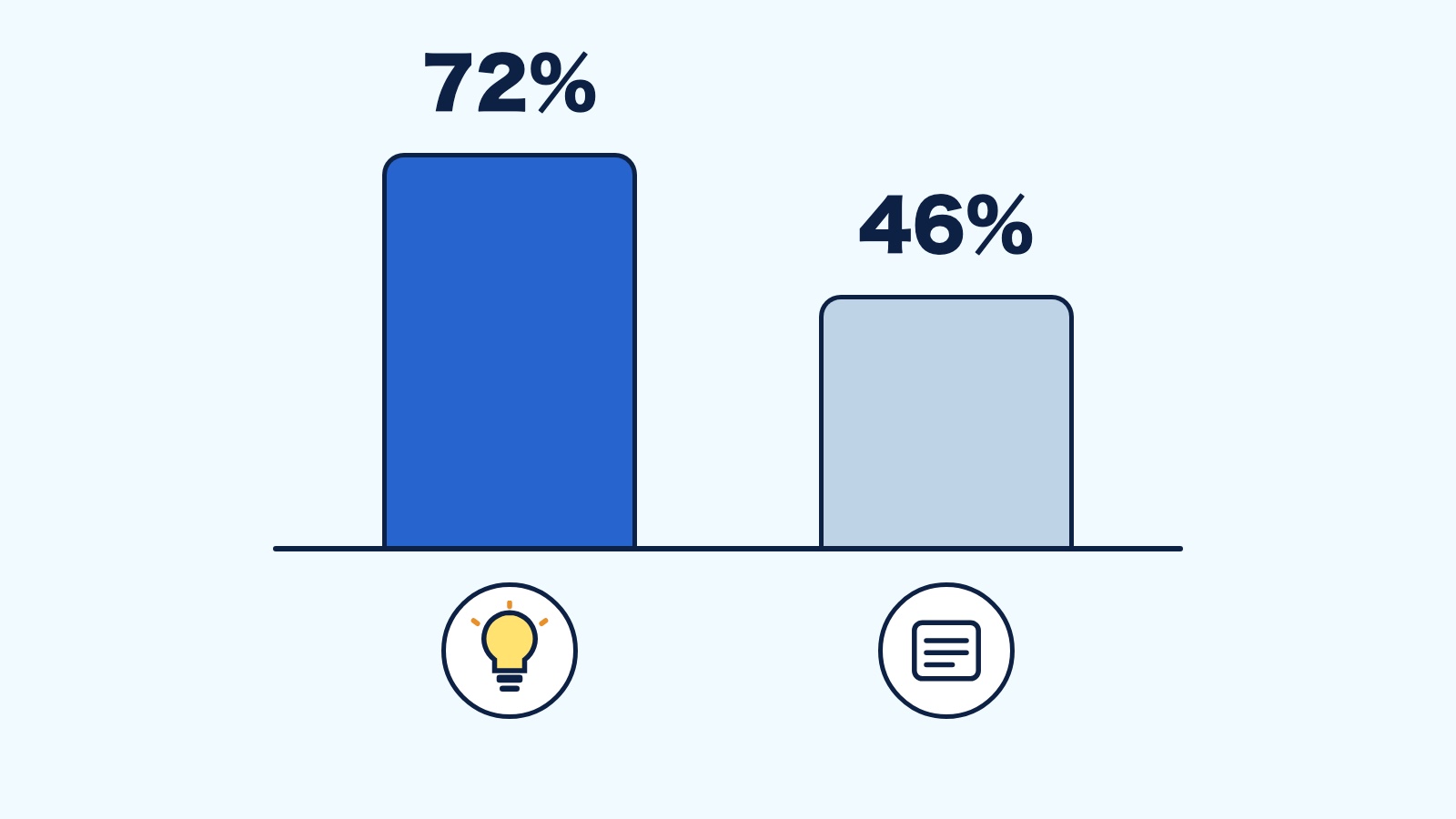
Recall on the main final test in Atkinson and Raugh (1975): 72% for learners who used keyword images (left), 46% for learners who studied their own way (right).
Breaking kanji into parts helps adult learners
Kanji give mnemonics something even better than sound-alike words: the characters are built from smaller, recurring parts. Mary Flaherty and Mary Sisk Noguchi compared two ways of teaching 30 kanji to 29 adult English speakers learning Japanese, some living in Japan and some in Ireland. The "whole-kanji" method had learners memorize each character as a unit, mainly by writing it again and again, the way Japanese schoolchildren traditionally learn. The "component analysis" method broke each kanji into its parts, gave each part a meaning, and tied the parts together with a story that pointed to the kanji's meaning. Learners were tested after the early sessions and again a month later. In both countries, the component group remembered significantly more (Flaherty & Noguchi, 1998). It was a small study, but it points the same way as the larger body of mnemonic research.
Point out the parts the first time you meet a character
When should you learn the parts? Marcus Taft and Kevin Chung taught Australian adults who knew no Chinese 24 characters, each paired with a meaning and each made of two parts from a set of 16. One group studied all 16 parts before seeing any characters. Another was asked to point out each character's parts on a chart the first time it appeared. A third did the same only on the third pass, and a fourth was never told about the parts at all. Memory for the meanings was best in the group that picked out the parts on first sight, which suggests the parts help most when they are highlighted as you meet each new character (Taft & Chung, 1999).
Stories you make yourself stick best
Should you use ready-made stories or invent your own? Mei-Liang Amy Kuo and Simon Hooper assigned 92 high-school students learning Chinese characters to one of five groups: translations only, ready-made verbal mnemonics, ready-made visual mnemonics, both together, or mnemonics they created themselves. Students who made their own scored higher on the posttest than the visual, verbal and translation groups, and the group given both pictures and words beat translations alone. Making your own took longer, though: those students spent more time on task than any other group (Kuo & Hooper, 2004).
The catch: mnemonic memories fade faster
Here is the part the memory-trick books rarely mention. In three experiments, Alvin Wang and Margaret Thomas found that people who learned with keyword mnemonics did better on an immediate test, but two days later the advantage reversed: learners who had studied the words in meaningful sentences remembered more. The authors concluded that keyword memories are especially fragile over time, and in their third experiment, extra chances to study helped the keyword learners more than the others (Wang & Thomas, 1995). A mnemonic is a strong first hook, not a finished memory.
Too clever, and the meaning gets lost
Heath Rose followed university students of Japanese for a year, with interviews, sessions where they talked through how they had studied, and a questionnaire about how they used mnemonics for kanji. Mnemonics helped when they were meaningful, but learners who leaned on them too hard ran into trouble. There were many accounts of a kanji's meaning getting lost inside an overly complex story. And because most stories link the character to its meaning, some learners knew what a kanji meant but could not read it aloud (Rose, 2013).
How to use kanji mnemonics well
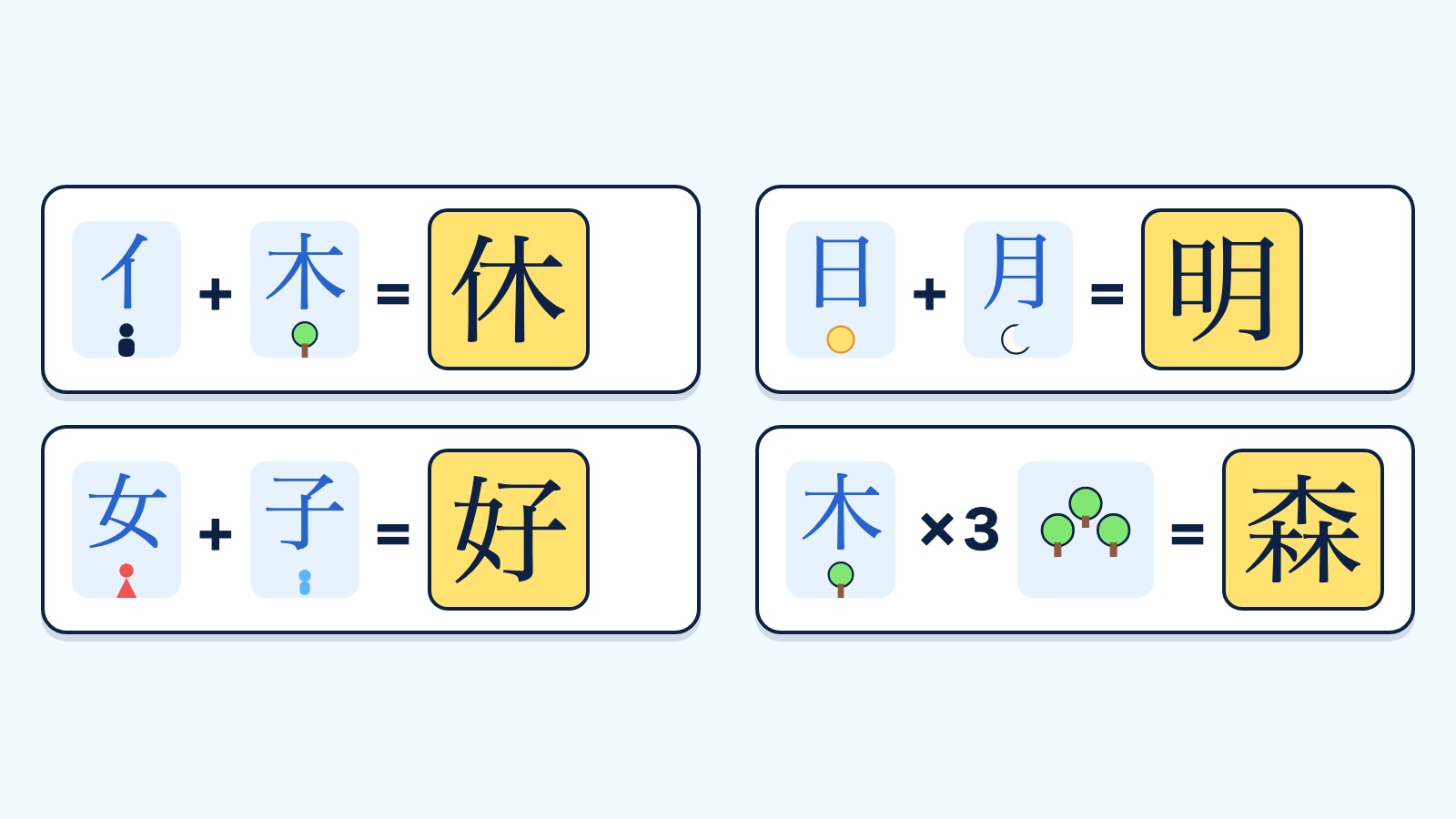
Four kanji and their parts: 亻 person + 木 tree = 休 rest; 日 sun + 月 moon = 明 bright; 女 woman + 子 child = 好 like; three 木 = 森 forest.
- Learn the parts as you go. You do not need a list of 200 components before you start. When a new kanji appears, name its parts first. A handful turn up everywhere: 亻 person, 木 tree, 日 sun or day, 口 mouth, 氵 water (three drops), 女 woman. Within a few weeks, new characters start to look like old friends rearranged.
- Make the story yourself, and keep it to one picture. 休: a person leaning on a tree, resting. 明: the sun and the moon together, as bright as it gets. 好: a woman holding her child, someone she likes very much. 森: one tree, then three, and you are in a forest. A story you invent is worth more than a clever one you read, but if it needs a paragraph, it is too long.
- Do not worry about history. Some stories match the traditional explanation of a character, as 休 does. Many popular ones are simply invented. A mnemonic only needs to be vivid and to point to the right meaning.
- Hook the reading too. Learn each kanji inside a word you can say: 休み (yasumi, a day off), 明るい (akarui, bright), 好き (suki, to like), 森 (mori, forest). Say the word out loud as you picture the story, so the sound comes with the meaning.
- Then test yourself, and come back later. Because mnemonic memories fade fast, the story is where the work starts. Cover the meaning and recall it from the character, and the other way round: that is retrieval practice. Then meet the kanji again tomorrow and next week, the way spaced repetition schedules it.
- Let the story go. After enough reviews you will read 休 as "rest" without picturing anyone under a tree. That is the goal. The scaffolding has done its job.
Try it in Miaru
In Miaru, the Japanese course teaches kanji grade by grade, in the order Japanese schools do. Each lesson opens with a short read that links its new characters with simple images, like "山 really is a mountain, three peaks in a row". Each kanji then gets a flashcard that draws the character stroke by stroke, with its meaning and its readings on the back. The questions that follow go both ways, from the character to its meaning and its reading and back again, some of them from audio, so the sound is practiced along with the meaning. Kanji you have learned come back in later lessons and in reviews when they are due.
Miaru does not write a story for every kanji. That part is yours, and the research says it works better that way. On the cover, Luffy is acting out 休, resting with a cup of tea beside a tree, while a sun and a moon (明) and a clump of three trees (森) hide in the same picture.
References
- Atkinson, R. C., & Raugh, M. R. (1975). An application of the mnemonic keyword method to the acquisition of a Russian vocabulary. Journal of Experimental Psychology: Human Learning and Memory, 1(2), 126–133. https://doi.org/10.1037/0278-7393.1.2.126
- Flaherty, M., & Noguchi, M. S. (1998). Effectiveness of different approaches to kanji education with second language learners. JALT Journal, 20(2), 60–78. https://jalt-publications.org/jj/articles/2769-effectiveness-different-approaches-kanji-education-second-language-learners
- Kuo, M.-L. A., & Hooper, S. (2004). The effects of visual and verbal coding mnemonics on learning Chinese characters in computer-based instruction. Educational Technology Research and Development, 52(3), 23–34. https://doi.org/10.1007/BF02504673
- Rose, H. (2013). L2 learners' attitudes toward, and use of, mnemonic strategies when learning Japanese kanji. The Modern Language Journal, 97(4), 981–992. https://doi.org/10.1111/j.1540-4781.2013.12040.x
- Taft, M., & Chung, K. (1999). Using radicals in teaching Chinese characters to second language learners. Psychologia, 42(4), 243–251. https://repository.eduhk.hk/en/publications/using-radicals-in-teaching-chinese-characters-to-second-language-/
- Wang, A. Y., & Thomas, M. H. (1995). Effects of keyword on long-term retention: Help or hindrance? Journal of Educational Psychology, 87(3), 468–475. https://doi.org/10.1037/0022-0663.87.3.468
