
7 min read
Watch, Then Write: How Miaru Teaches Stroke Order
Every kana and kanji card in Miaru draws itself stroke by stroke. What the research says about writing by hand, and how to practice along.
- japanese
- kanji
- writing
Write the Japanese character あ and you make three strokes: a short line across the top, a long one down through it, then a sweeping loop. You could make the same shape in another order, and on a screen nobody would know. Your hand would, though, and that turns out to matter more than it seems.
In Miaru, every card that shows a single kana or kanji draws itself, one stroke at a time, in the order a Japanese child learns at school. This post covers what the research says about writing characters by hand, why the order is worth learning, and how to get the most out of those animated cards.
What the research says about writing by hand
Writing sharpens the picture of a character
Connie Qun Guan and colleagues taught Chinese to adult second-language learners with an online tutor. In one version, learners wrote each character by hand; in another, they only read. The writers got better at recognizing the characters and at linking each one to its meaning. In a second experiment, a version where learners typed the pinyin spelling helped them link characters to their sounds instead. Writing trained the form, typing trained the pronunciation. The authors' practical advice was to combine both (Guan et al., 2011).
It is the movement, not just the extra time
A fair objection: maybe writing works simply because it slows you down and keeps you looking at the shape. Robert Wiley and Brenda Rapp tested that. They taught 42 adults with no previous knowledge of Arabic 20 letters of its alphabet, by writing them, typing them, or looking at them and doing a visual task. The writing group learned fastest and did best on tests of skills they had never practiced, such as reading and spelling. Only handwriting built both a memory of the movement and an abstract sense of each letter's identity (Wiley & Rapp, 2021).
Even small children recognize what they have written
Marieke Longcamp and colleagues trained two groups of 38 children aged three to five to copy letters, either by hand or on a keyboard, for three weeks. On recognition tests afterwards, the older children who had learned by hand recognized letters better than those who had typed them (Longcamp, Zerbato-Poudou & Velay, 2005).
In Chinese, reading goes with writing
Li Hai Tan and colleagues tested 131 schoolchildren in Beijing. How well a child could copy made-up characters was clearly related to how well they read real ones, even after the researchers accounted for nonverbal IQ (r = 0.45 for beginning readers, r = 0.34 for intermediate ones). The link between reading and awareness of speech sounds, so central for alphabets, was much weaker. The authors propose that writing helps through two routes: a sharper sense of how characters are built, and motor memories of the characters themselves (Tan et al., 2005). This study is correlational, so on its own it cannot show that writing causes better reading, but it fits the training studies above.
One honest caveat runs through all of this. These studies compare writing with typing or looking. Watching an animation is looking. The animation shows you how a character is made; your own hand is what does the learning.
Why the stroke order matters
If writing builds a memory of the movement, it helps to make the same movement every time. A fixed stroke order turns each character into one repeatable motion instead of a dozen slightly different ones. It also makes your handwriting readable, because the strokes join the way a reader expects.
The order is not arbitrary, and a few rules cover most characters:
- Top to bottom, left to right. The first stroke of あ is the short line at the top.
- Horizontal before a vertical that crosses it. In 十 (ten), the line across comes first.
- A box is drawn left side, then top and right in one stroke, and closed last. In 日 (day, sun), the inside line comes before the bottom line that closes the box.
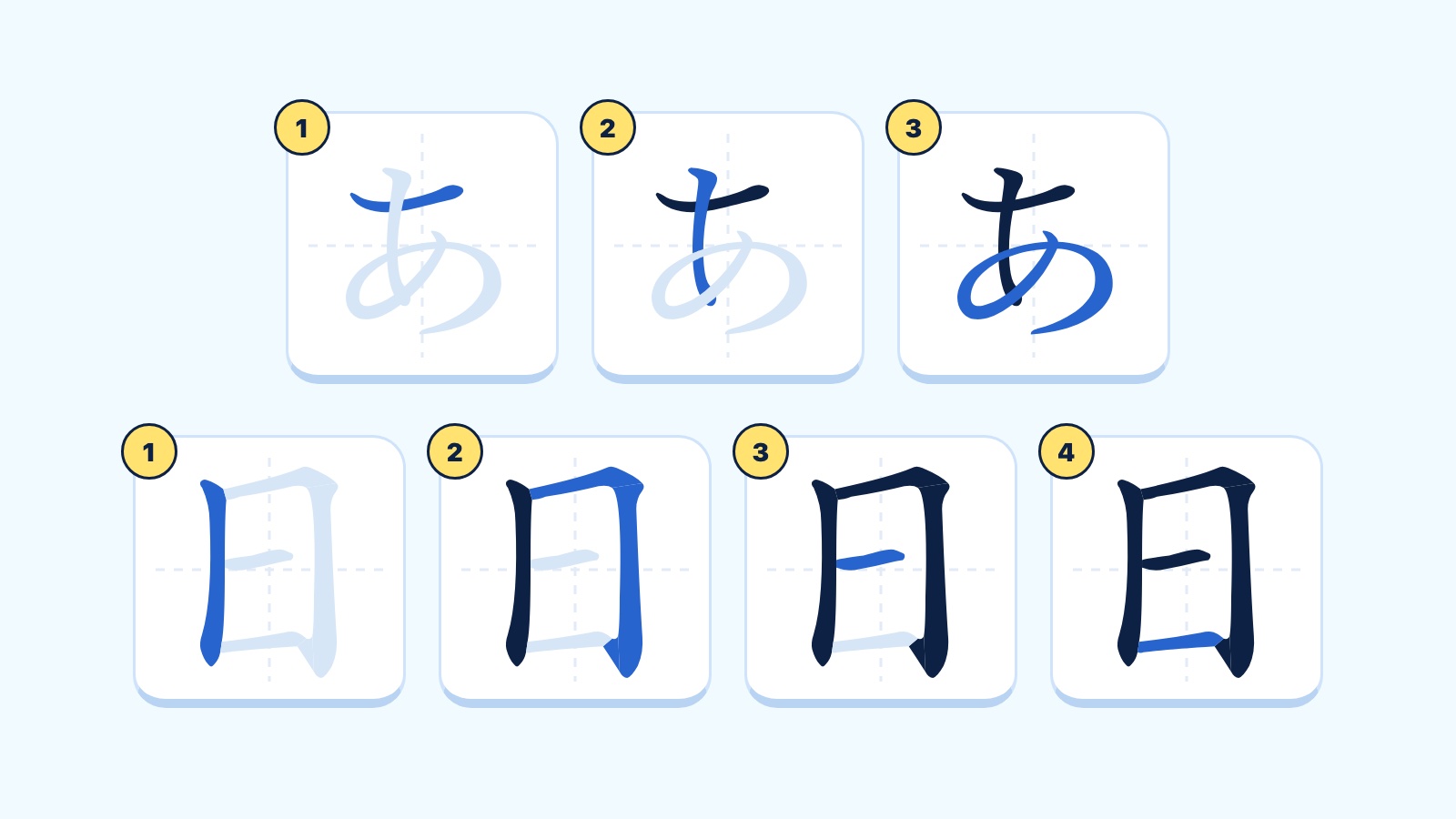
あ in three strokes and 日 in four. Each frame adds one stroke: blue is the stroke being drawn, navy the strokes already done. Drawn from the same stroke data the Miaru app uses.
Learn these rules on a handful of easy characters and the next hundred go faster, because you start to see new characters as familiar parts written in a familiar order.
How Miaru shows it
In Miaru's Japanese course, every lesson that introduces new characters has a flashcard for each one. When the front of the card shows a single hiragana, katakana or kanji, that character draws itself: a faint shadow of the whole character appears first, then each stroke is drawn over it in order, a little under half a second per stroke. The finished character holds for a moment and the animation starts again, so you can watch it as many times as you like. Tap the card to see its reading or meaning and, where the card has audio, press Listen to hear it.
After the card you rate how well you knew it (Again, Hard, Good or Easy), and that rating decides when the character comes back in your reviews. Then the lesson moves on to practice, such as matching characters to their sounds or meanings, or picking the character you hear from four choices.
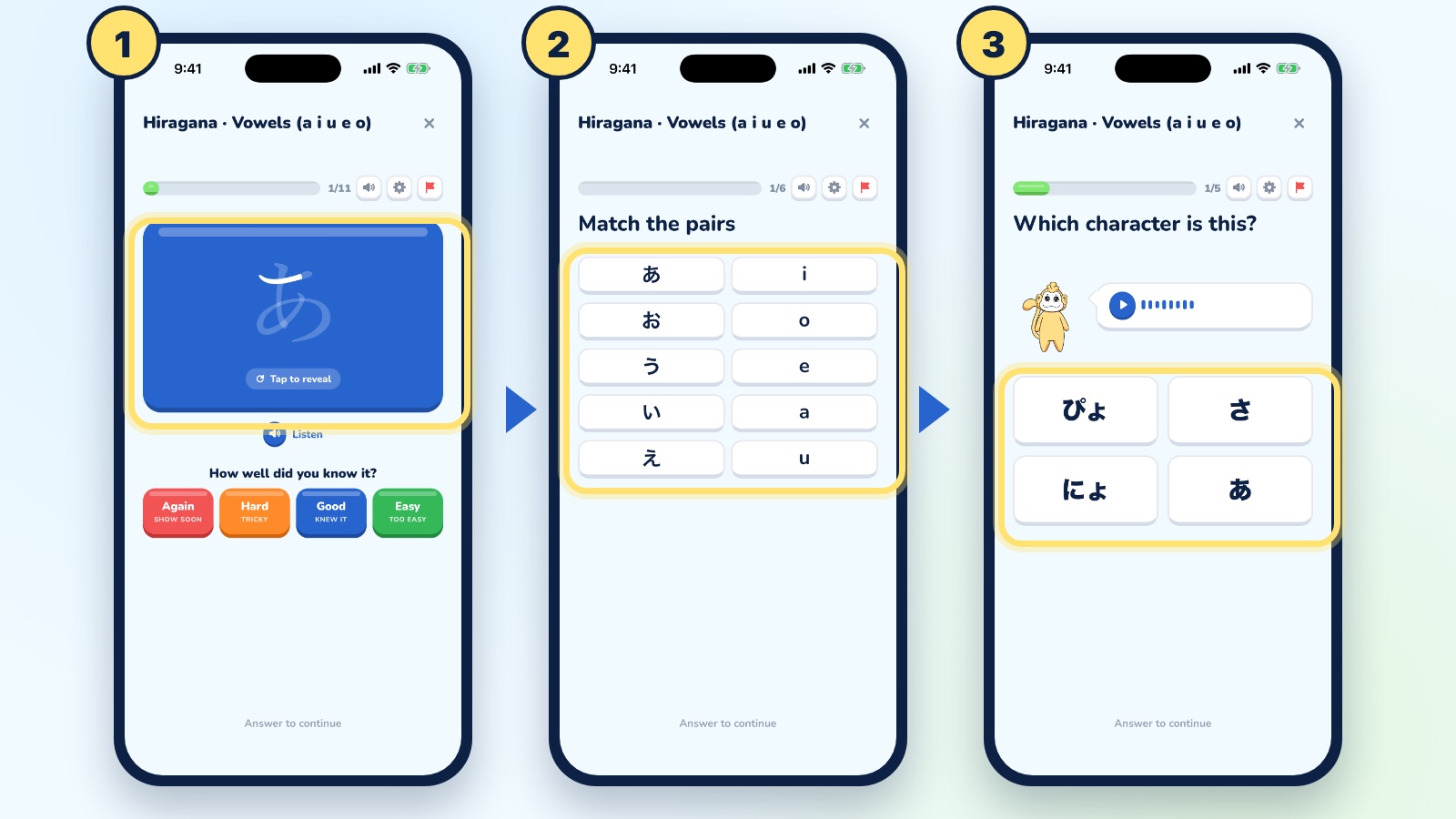
A hiragana lesson in Miaru: (1) the card draws あ stroke by stroke, (2) match each character to its sound, (3) pick the character you hear.
Two things to know. If you have turned on Reduce Motion on your phone, the card shows the finished character without animating. And Miaru does not check your handwriting: the writing part is yours, on paper. That is the part the research above says matters most.
How to practice along
- Watch one full loop before you write. Notice where each stroke starts and which way it moves.
- Trace it with your finger on the table or in the air while the next loop plays.
- Write it three to five times on paper, saying the reading aloud as you go. Paper with a centre cross, like the guide lines in the diagram above, helps you place each stroke.
- Write it once from memory. Later in the lesson, when a character comes up in matching or the listening question, write it before you answer. Pulling it from memory is retrieval practice, and it sticks far better than copying.
- Keep it short and spread out. A few characters a day, revisited when the app brings them back for review, beats a long session of copying the same one fifty times.
Try it in Miaru
Open Miaru and start the Hiragana unit of the Japanese course. The first card draws あ for you. Keep a pencil and some paper next to your phone. To see what else happens in a lesson, read inside a Miaru lesson. On the cover, Luffy is halfway through a first stroke with a giant brush, while the strokes still to come wait on the paper.
References
- Guan, C. Q., Liu, Y., Chan, D. H. L., Ye, F., & Perfetti, C. A. (2011). Writing strengthens orthography and alphabetic-coding strengthens phonology in learning to read Chinese. Journal of Educational Psychology, 103(3), 509–522. https://doi.org/10.1037/a0023730
- Longcamp, M., Zerbato-Poudou, M.-T., & Velay, J.-L. (2005). The influence of writing practice on letter recognition in preschool children: A comparison between handwriting and typing. Acta Psychologica, 119(1), 67–79. https://doi.org/10.1016/j.actpsy.2004.10.019
- Tan, L. H., Spinks, J. A., Eden, G. F., Perfetti, C. A., & Siok, W. T. (2005). Reading depends on writing, in Chinese. Proceedings of the National Academy of Sciences, 102(24), 8781–8785. https://doi.org/10.1073/pnas.0503523102
- Wiley, R. W., & Rapp, B. (2021). The effects of handwriting experience on literacy learning. Psychological Science, 32(7), 1086–1103. https://doi.org/10.1177/0956797621993111
