
8 min read
Sleep on It: How Sleep Helps You Remember New Words
Sleep after studying helps new words stick, and timing matters. What the research says, and how to plan your study day around a good night's sleep.
- learning-science
- memory
- vocabulary
You learn ten new words before bed. In the morning they feel a little more solid, as if they had settled in overnight. That feeling is not just in your head. Or rather, it is in your head, and research has watched it happen. Sleep is not a break from learning: it is one of the steps of it. Here is what studies of sleep and word learning have found, how sure we can be, and how to arrange your study day so that your nights help.
Learning a word happens in two steps
Picking up a new word is fast. Within a few minutes of practice you can recognise it and maybe even say it. But a word that is merely familiar is not yet part of your vocabulary in the way apple or tomorrow are. Those words pop up on their own when you need them, and they come linked to everything else you know.
Memory researchers describe two steps. First, your brain stores the new word quickly as a fresh, fragile memory. Then, over hours and days, it is woven into long-term memory and linked to the words you already have. That second step is called consolidation, and a large body of research suggests that sleep plays an important part in it (Walker & Stickgold, 2006).
What the research says
Sleeping soon after you learn helps you remember
In a study by Steffen Gais and colleagues, high school students learned vocabulary and were tested later. They remembered more when sleep came within a few hours of learning. The researchers checked that this was about sleep itself, not the time of day or how much else the students did in between. Losing a night's sleep after learning hurt memory, and the damage was still there after a night of recovery sleep (Gais et al., 2006).
New words join your vocabulary overnight
One clever way to tell whether a new word has truly joined your vocabulary is to see whether it starts to compete with words you know. Teach someone a made-up word such as cathedruke, and once it has settled in, it should slow them down a tiny bit when they hear the real word cathedral, because both now come to mind at once.
Nicolas Dumay and Gareth Gaskell found that this competition needed sleep. People who learned new words at 8 p.m. showed it the next morning, after a night's sleep. People who learned them at 8 a.m. did not show it that evening, after twelve hours awake. They showed it only the following day, once they too had slept (Dumay & Gaskell, 2007).
A follow-up study recorded people's sleep in the lab. After a night's sleep, learners recalled more of the new words and recognised them faster. The group that stayed awake showed no such gains until a test a week later. The study also linked the new words joining the vocabulary to sleep spindles, short bursts of brain activity during sleep (Tamminen et al., 2010).
Sleeping between two study sessions halves the work
This one is the most practical study of the lot. Stéphanie Mazza and colleagues had 40 people learn foreign words until they knew all of them, then relearn them 12 hours later. Half did both sessions on the same day, morning and evening. The other half learned in the evening, slept, and relearned the next morning.
The group that slept in between needed only half as much practice to relearn the words. A week later, and again six months later, they also remembered far more (Mazza et al., 2016). The authors' conclusion fits on a sticky note: sleeping after learning is good, and sleeping between two study sessions is better.
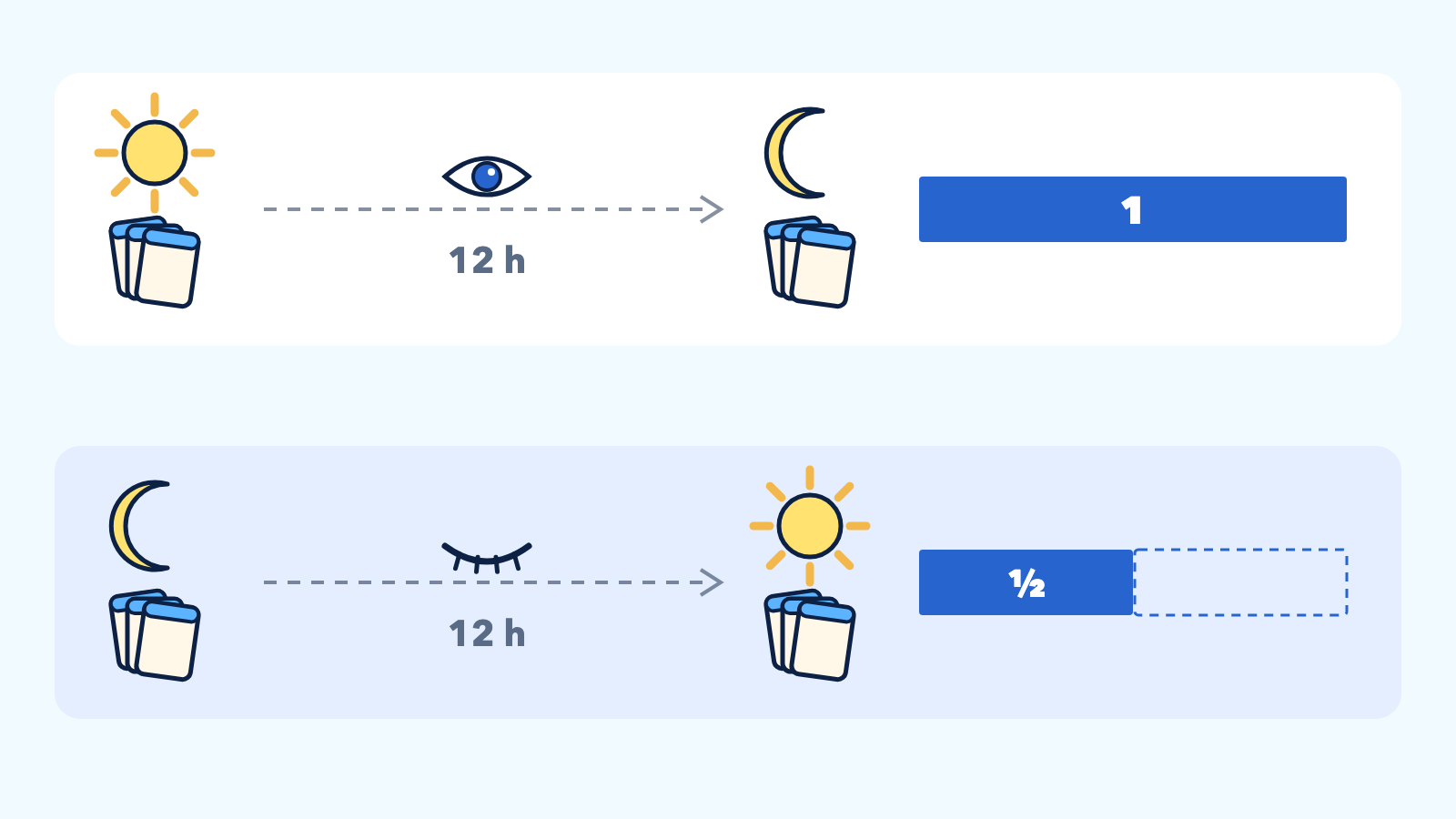
Two ways to space the same two sessions 12 hours apart. With a night's sleep in between (bottom), relearning took half the practice. Design and result: Mazza et al. (2016).
Across 25 studies, sleep wins
One study can be a fluke, so it helps to look at many. A 2021 meta-analysis gathered 25 studies of adults learning new words, with 1,396 participants in all. On average, people who slept after learning did better than people who stayed awake, with an effect size of g = 0.50, a moderate effect. The benefit held across different kinds of test. It was largest for recalling words (g = 0.57) and recognising them (g = 0.52), and smaller for measures of words joining the vocabulary (g = 0.39) (Schimke et al., 2021).
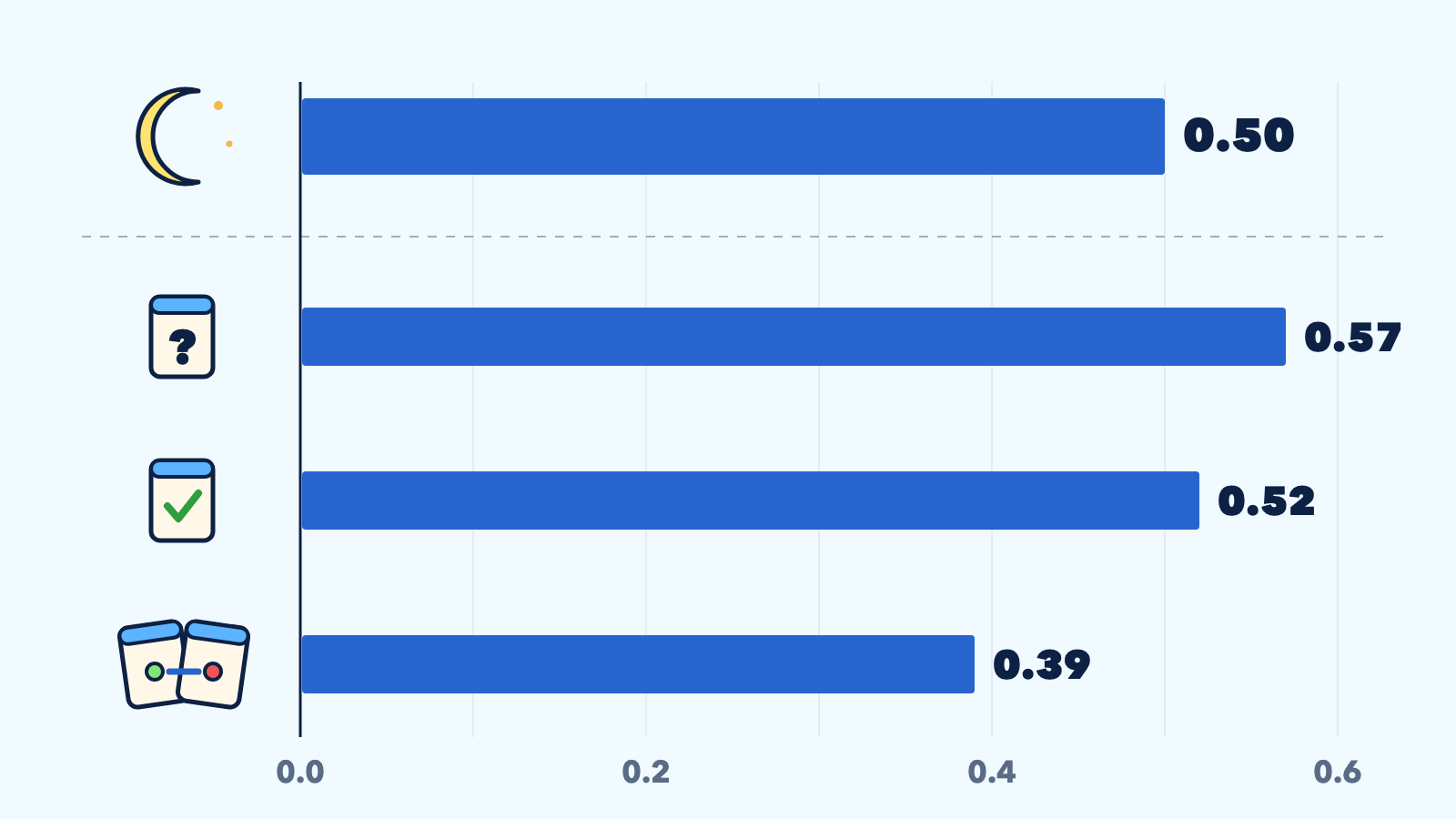
How much sleep helped, compared with time awake, as effect sizes (Hedges' g). Top: all 25 studies. Below: recalling words, recognising them, and new words joining the vocabulary. Data: Schimke et al. (2021).
Sleep before learning matters too
Sleep also gets your brain ready for the next day's learning. In a brain-imaging study, people who had been kept awake all night showed weaker activity in the hippocampus, a brain area central to forming new memories, while they learned. They also remembered less of what they had learned (Yoo et al., 2007). An all-nighter costs you twice: it weakens what you learned yesterday and what you try to learn today.
Can you learn words in your sleep?
Not new ones, and not from a playlist. In one lab study, Dutch words that people had already learned while awake were played to them quietly during non-REM sleep. Later, they remembered the German translations of those words better than the translations of words that were not played. Playing the same words to people who were awake did not help (Schreiner & Rasch, 2015). The words were timed to a stage of sleep the researchers monitored with brain recordings, so this is a window into how sleep strengthens memories, not a shortcut. The learning still happens while you are awake.
How strong is the evidence?
Fairly strong that sleep helps, with fair warning that the effect is not magic. A review by Maren Cordi and Björn Rasch looked at failed replications and studies with null results. It concluded that sleep's benefits for memory are smaller, depend more on the task, and last less long than researchers once thought (Cordi & Rasch, 2021). So think of sleep as a reliable helper, not a substitute for practice. The meta-analysis above still found a clear average benefit across 25 studies.
How to use it today
- Learn new words in the evening. Put your new vocabulary in the last few hours before bed, when sleep will follow soon. Morning and lunchtime are fine for listening, reading or review.
- Review them the next morning. Before you add anything new, test yourself on last night's words. That is the schedule from the Mazza study: learn, sleep, relearn. Test yourself rather than rereading, because retrieval practice beats rereading.
- Don't trade sleep for study time. An extra hour of flashcards at 1 a.m. costs you more than it earns. You remember less of what you just studied, and you learn less the next day.
- Don't judge a word by the evening. A word that feels shaky at night may come back more easily in the morning. If it doesn't, relearning it is quicker the second time.
- Keep spacing after that. Sleep handles the first night. After that, review at growing intervals, which is spaced repetition.
Want words to practise on tonight? Here are two, in four languages: "to sleep" and "dream". In Japanese, 寝る (neru) and 夢 (yume). In Korean, 자다 (jada) and 꿈 (kkum). In Mandarin, 睡觉 (shuìjiào) and 梦 (mèng). In Spanish, dormir and sueño, which means both "dream" and "sleepiness". Learn them tonight, then see how many you can recall over breakfast.
Try it in Miaru
Miaru is set up to work with your nights. You choose the hour of your daily practice reminder, so you can set it for the evening, a few hours before bed. Each word you learn in a lesson comes back for its first review one day later, after a night's sleep. It shows up at the start of your next lesson or in a review round, and both ask you to recall it, not just look at it. Our post on how Miaru brings your words back explains the whole schedule.
On the cover, Luffy is fast asleep on a giant pillow while the words he learned today drift up to join the stars. His friend AI works the night shift. Do a short lesson this evening, sleep on it, and see what has stayed with you in the morning.
References
- Cordi, M. J., & Rasch, B. (2021). How robust are sleep-mediated memory benefits? Current Opinion in Neurobiology, 67, 1–7. https://doi.org/10.1016/j.conb.2020.06.002
- Dumay, N., & Gaskell, M. G. (2007). Sleep-associated changes in the mental representation of spoken words. Psychological Science, 18(1), 35–39. https://doi.org/10.1111/j.1467-9280.2007.01845.x
- Gais, S., Lucas, B., & Born, J. (2006). Sleep after learning aids memory recall. Learning & Memory, 13(3), 259–262. https://doi.org/10.1101/lm.132106
- Mazza, S., Gerbier, E., Gustin, M.-P., Kasikci, Z., Koenig, O., Toppino, T. C., & Magnin, M. (2016). Relearn faster and retain longer: Along with practice, sleep makes perfect. Psychological Science, 27(10), 1321–1330. https://doi.org/10.1177/0956797616659930
- Schimke, E. A. E., Angwin, A. J., Cheng, B. B. Y., & Copland, D. A. (2021). The effect of sleep on novel word learning in healthy adults: A systematic review and meta-analysis. Psychonomic Bulletin & Review, 28(6), 1811–1838. https://doi.org/10.3758/s13423-021-01980-3
- Schreiner, T., & Rasch, B. (2015). Boosting vocabulary learning by verbal cueing during sleep. Cerebral Cortex, 25(11), 4169–4179. https://doi.org/10.1093/cercor/bhu139
- Tamminen, J., Payne, J. D., Stickgold, R., Wamsley, E. J., & Gaskell, M. G. (2010). Sleep spindle activity is associated with the integration of new memories and existing knowledge. Journal of Neuroscience, 30(43), 14356–14360. https://doi.org/10.1523/JNEUROSCI.3028-10.2010
- Walker, M. P., & Stickgold, R. (2006). Sleep, memory, and plasticity. Annual Review of Psychology, 57, 139–166. https://doi.org/10.1146/annurev.psych.56.091103.070307
- Yoo, S.-S., Hu, P. T., Gujar, N., Jolesz, F. A., & Walker, M. P. (2007). A deficit in the ability to form new human memories without sleep. Nature Neuroscience, 10(3), 385–392. https://doi.org/10.1038/nn1851
