
6 min read
Streaks, XP and the Leaderboard: How They Work in Miaru
How Miaru's day streak, streak freezes, XP and weekly leaderboard work, what habit research says about missed days, and how to use them well.
- miaru
- habits
- motivation
Open your profile in Miaru and three numbers greet you: your day streak with its little flame, your total XP with its lightning bolt, and your plan. They look like a game, and in a way they are. But behind each one is a plain rule, and once you know the rules, you can use them to build the thing that actually makes you fluent: a habit of practicing a little every day.
This post explains how streaks, XP and the weekly leaderboard work in Miaru, what the research on habits says about streaks, and how to make the numbers work for you instead of the other way round.
What the research says about building a habit
Phillippa Lally and her colleagues at University College London asked 96 volunteers to pick one new eating, drinking or activity habit and do it every day in the same situation, such as "after breakfast", for 12 weeks. Every day the volunteers rated how automatic the behavior felt. For the volunteers whose data fit the researchers' model, automaticity rose quickly at first and then leveled off, along a curve. How long it took to get close to that plateau varied enormously: from 18 days for some people to an estimated 254 days for others. And one finding matters a lot for streaks: missing a single opportunity did not materially affect the habit forming (Lally et al., 2010).
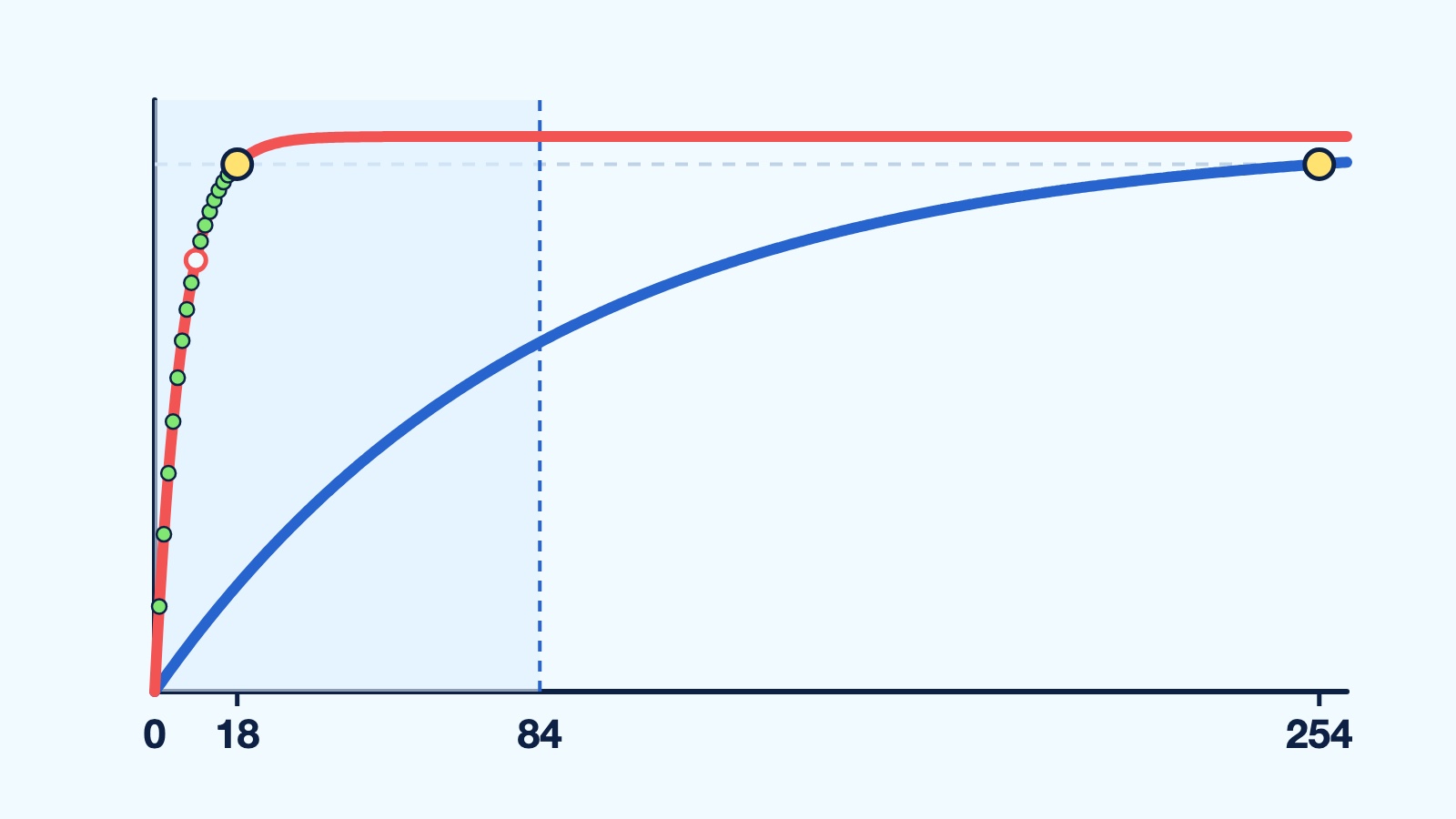
The shape Lally et al. (2010) found: automaticity rises along a curve and levels off. Reaching 95% of that level took from 18 days to an estimated 254 days (the study itself ran for 84 days, the shaded area). A missed day (the open circle) did not materially change the curve. The two curves are illustrations of that range, not individual data.
Three lessons come out of this. Tie your practice to a fixed moment in your day, because a consistent cue is what the habit attaches to. Expect it to take weeks or months, not a magic 21 days. And do not panic about one missed day; what matters is coming back the next.
How the day streak works
Your streak counts the days in a row on which you practiced. Any of these counts for the day: finishing a lesson, finishing a review round, or finishing a call with Luffy. The day is your own calendar day, in your time zone, so a lesson at 11 p.m. counts for today. Practicing again on a day that already counts changes nothing; the streak goes up by one per day, not per lesson.
A streak stays alive until the end of the day after the last day you practiced. Miss a whole day and the streak ends, and your next practice starts a new one at 1.
That is where streak freezes come in. In the Shop you can buy a streak freeze for 100 sapphires, and you can hold up to two. Each freeze covers one missed day. When you come back after a gap that your freezes cover, Miaru asks whether you want to use them to keep your streak. A frozen day keeps the streak alive but does not add to the count. In other words, the app builds in exactly the slack the research says a habit can afford: a missed day now and then is fine, as long as you come back.
Some streaks get a small celebration: days 7, 14, 30, 50, 100 and 365 come with extra confetti.
How you earn XP
XP in Miaru is deliberately simple. In a lesson you get one XP for every question you answer correctly, plus one for finishing. Replaying a lesson only earns the XP you add above your best attempt so far, so you cannot farm points from a lesson you already know. Review rounds earn one XP for every three correct answers, up to 5 XP per round and 10 a day. The total on your profile therefore reads roughly as "answers I got right".
Every XP also earns you one sapphire to spend in the Shop, on things like streak freezes. On the lesson-complete screen you will also see your longest combo: the most answers you got right in a row in that lesson. It is there for fun and does not change your XP.
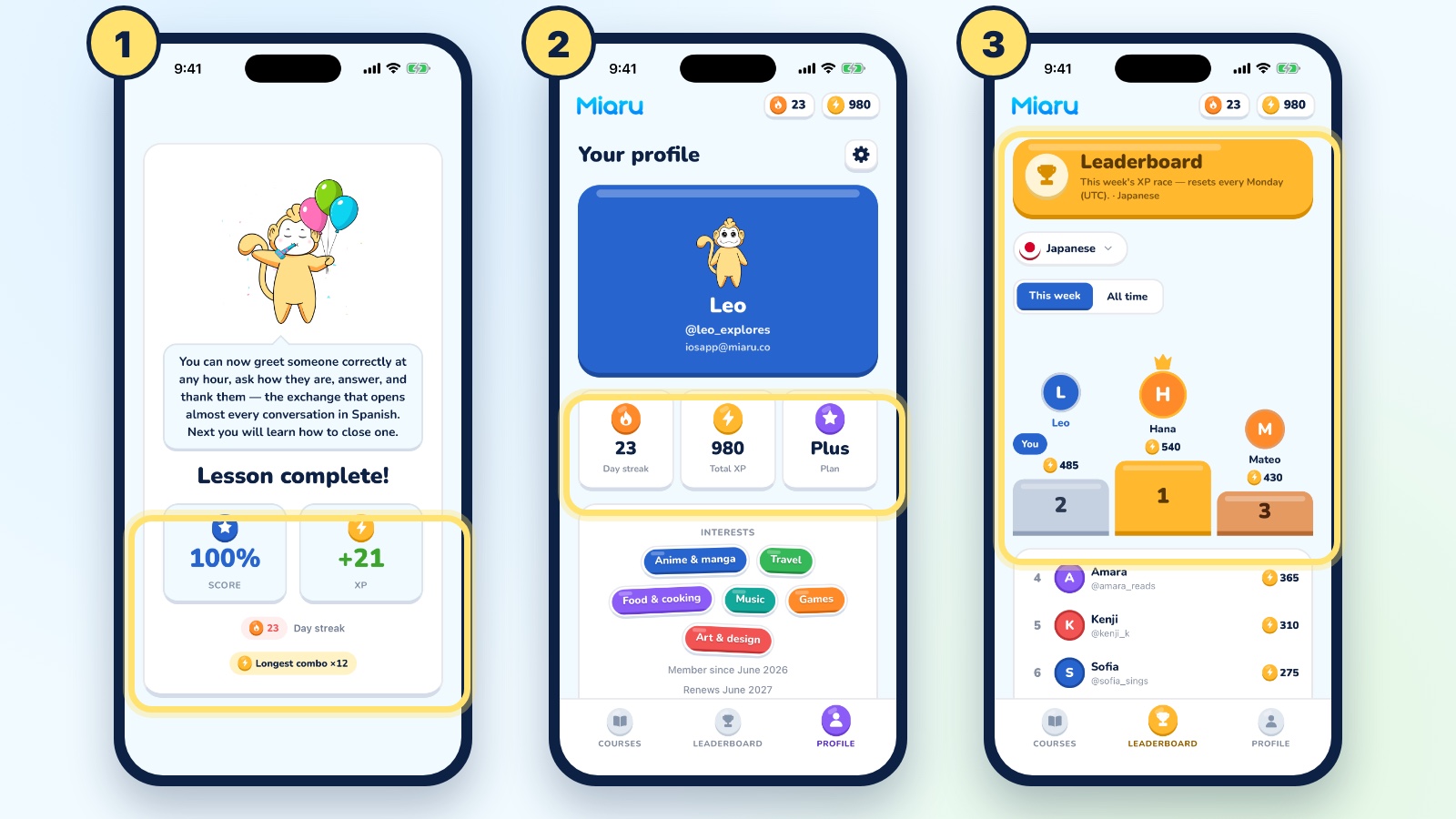
Where the numbers show up in Miaru: (1) the lesson-complete screen with your score, the XP you earned, your streak and your longest combo; (2) your profile; (3) the weekly leaderboard for a course.
How the weekly leaderboard works
Each course has its own leaderboard, a weekly XP race that resets every Monday (UTC). It shows the top 100 learners of that course by the XP they earned this week, from lessons, review rounds and calls alike. Switch to "All time" to see the ranking by total XP in the course. There are no prizes for placing; the medals are just for pride.
How to make the numbers work for you
- Pick your cue. Choose one moment that already happens every day, like your morning coffee or the train home, and practice right then. Set your practice reminder to that hour: Miaru sends at most one reminder a day, at the time you choose (7 p.m. unless you change it), and only if you have not practiced yet. You can turn email and push reminders on or off separately.
- Make the minimum small. One lesson or one review round keeps your streak. On busy days, do the minimum and stop. A small habit you keep beats a big one you drop.
- Keep a freeze in the bank. The research says one missed day will not undo a habit, but it can feel like it does if your streak drops to zero. A freeze or two in reserve takes the sting out of a bad day, so you come back instead of giving up.
- Chase right answers, not points. Because XP comes from correct answers, the honest way up the leaderboard is to learn more. Compare yourself with last week rather than with the person in first place.
- Let the streak become invisible. The goal is the day you practice because it is simply what you do after breakfast, and only notice the flame afterwards.
Try it in Miaru
Open Miaru, finish a lesson, and your streak starts at 1. To see what happens inside a lesson, read inside a Miaru lesson. A call with Luffy counts for your streak too; here is how speaking practice works. On the cover, Luffy brings one more log to the campfire he keeps going every day, with the woodpile for the days to come beside it and three boulders behind standing like a podium.
References
- Lally, P., van Jaarsveld, C. H. M., Potts, H. W. W., & Wardle, J. (2010). How are habits formed: Modelling habit formation in the real world. European Journal of Social Psychology, 40(6), 998–1009. https://doi.org/10.1002/ejsp.674
