
7 min read
Is There a Critical Period for Language? What the Data Says
Is it too late to learn a language as an adult? What studies of 669,498 speakers, immigrants and classrooms say about age, accent and learning speed.
- learning-science
- age
- pronunciation
"Kids pick up languages like sponges. After puberty, the window closes." You have probably heard some version of this, maybe as a reason not to start. It sounds like settled science, and part of it is: age really does matter for some things. But the research says something more interesting, and a lot more encouraging, than "too late".
The idea has a name: the critical period hypothesis. It goes back to Eric Lenneberg, who proposed in 1967 that language can only be acquired within a critical period from early infancy until puberty (Johnson & Newport, 1989). Here is what the studies have found since, and what it means if you are learning a language now.
What the research says
Earlier arrivals end up with better grammar
In a classic study, Jacqueline Johnson and Elissa Newport tested the English grammar of 46 Korean and Chinese speakers who had moved to the United States between the ages of 3 and 39. The earlier people arrived, the better they did, in a straight line up to puberty. After puberty, scores were lower but varied a lot, and they were no longer related to the age of arrival (Johnson & Newport, 1989). That is the pattern most people have in mind when they say the window closes.
But older learners are faster at the start
A decade earlier, Catherine Snow and Marian Hoefnagel-Höhle followed English speakers of different ages learning Dutch in the Netherlands, testing them three times in their first year. The 12–15-year-olds and the adults made the fastest progress in the first few months. By the end of the year the 8–10 and 12–15-year-olds were ahead, and the 3–5-year-olds scored lowest on every test (Snow & Hoefnagel-Höhle, 1978). Young children are not faster learners. Their advantage, where there is one, shows up over many years.
The biggest study: ability holds until about 17
Most age studies had a few dozen or a few hundred people. Joshua Hartshorne, Joshua Tenenbaum and Steven Pinker had 669,498 native and non-native English speakers, and a model that separates three things the older studies mixed up: your current age, the age you started, and how many years you have been learning (Hartshorne et al., 2018). Their findings:
- The ability to learn grammar holds until about 17.4 years old, then declines steadily. That is far later than the "closes at age 5" or "closes at puberty" of popular wisdom.
- Reaching the very top takes a long time. Even native speakers did not level off until around age 30. So to end up at a native-like level of grammar, you need to start early enough to put in many years at that full learning rate. For learners living in an English-speaking country, final scores barely dropped for those who started before about 12, then fell faster.
- It is about grammar only. The authors note that the timeline may differ for pronunciation and vocabulary, and that adults may use conscious strategies and explicit instruction in ways children do not.
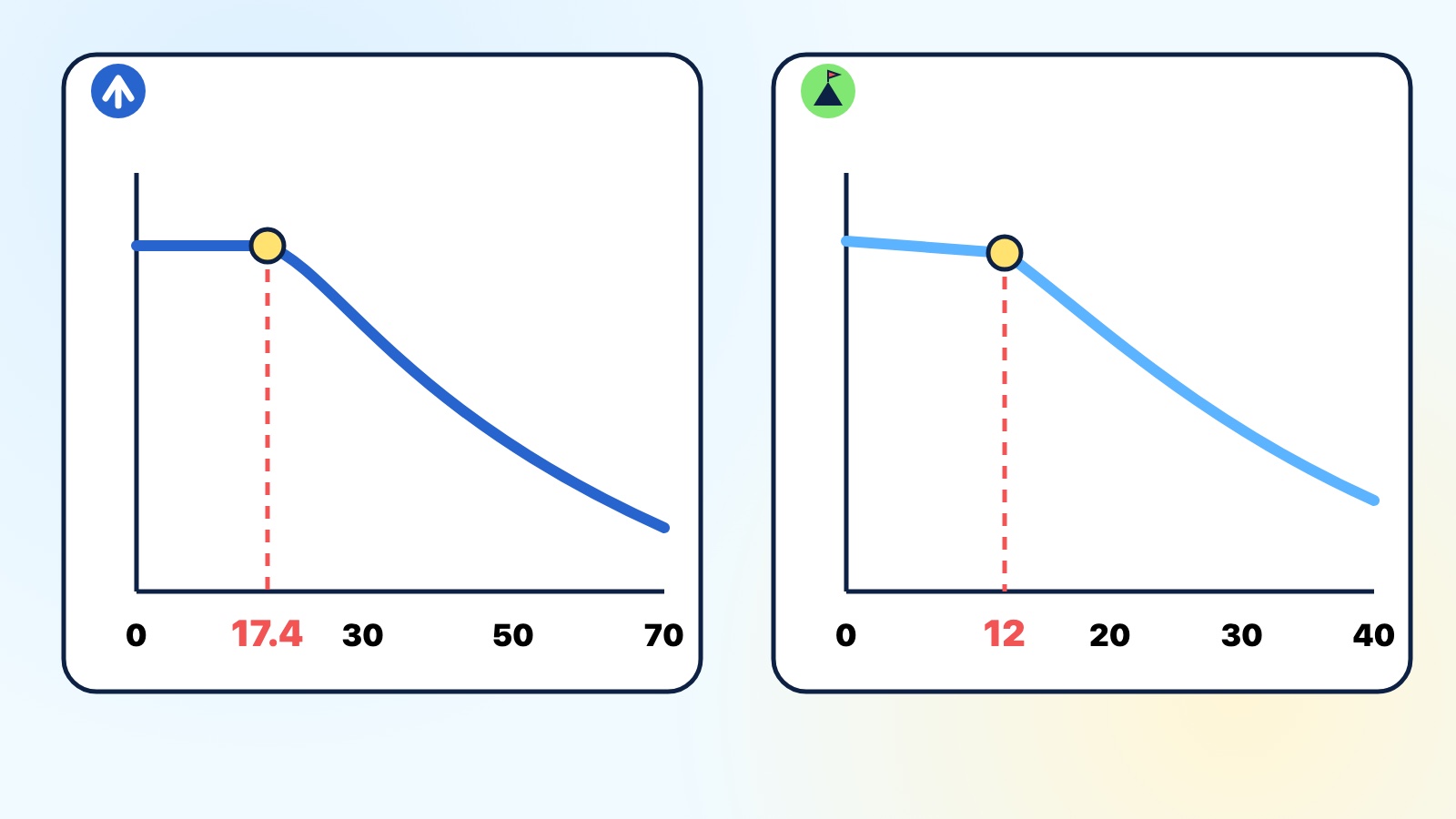
A simplified picture of Hartshorne et al. (2018). Left: how fast grammar is learned, by age (flat until 17.4). Right: the final level reached by learners immersed in English, by the age they started (nearly flat until 12). Shapes are schematic, not the paper's exact curves.
"Native-like" is a rare bar, even for early starters
Niclas Abrahamsson and Kenneth Hyltenstam recruited 195 Spanish speakers living in Sweden who all believed their Swedish could pass as native. When native listeners judged their speech, most of those who had started before age 12 passed, but only a small minority of later starters did. Then 41 of those who passed took a battery of ten very demanding language tasks. None of the late starters scored in the native range, and only a few of the early starters did on every measure (Abrahamsson & Hyltenstam, 2009). In other words, sounding native to everyday listeners is common among early learners and possible for some late ones. Being identical to a native speaker under the microscope is rare for almost everyone.
Accent is where age shows most, but it is not the whole story
James Flege, Murray Munro and Ian MacKay asked native English listeners to rate the accents of 240 Italian speakers in Canada who had started learning English between ages 2 and 23 and had lived there for 32 years on average. Very few who began after 15 sounded fully native, and even many who started in childhood had a detectable accent. The age at which people started learning explained 59% of the differences in accent. How much they used English and Italian explained another 15% (Flege, Munro & MacKay, 1995).
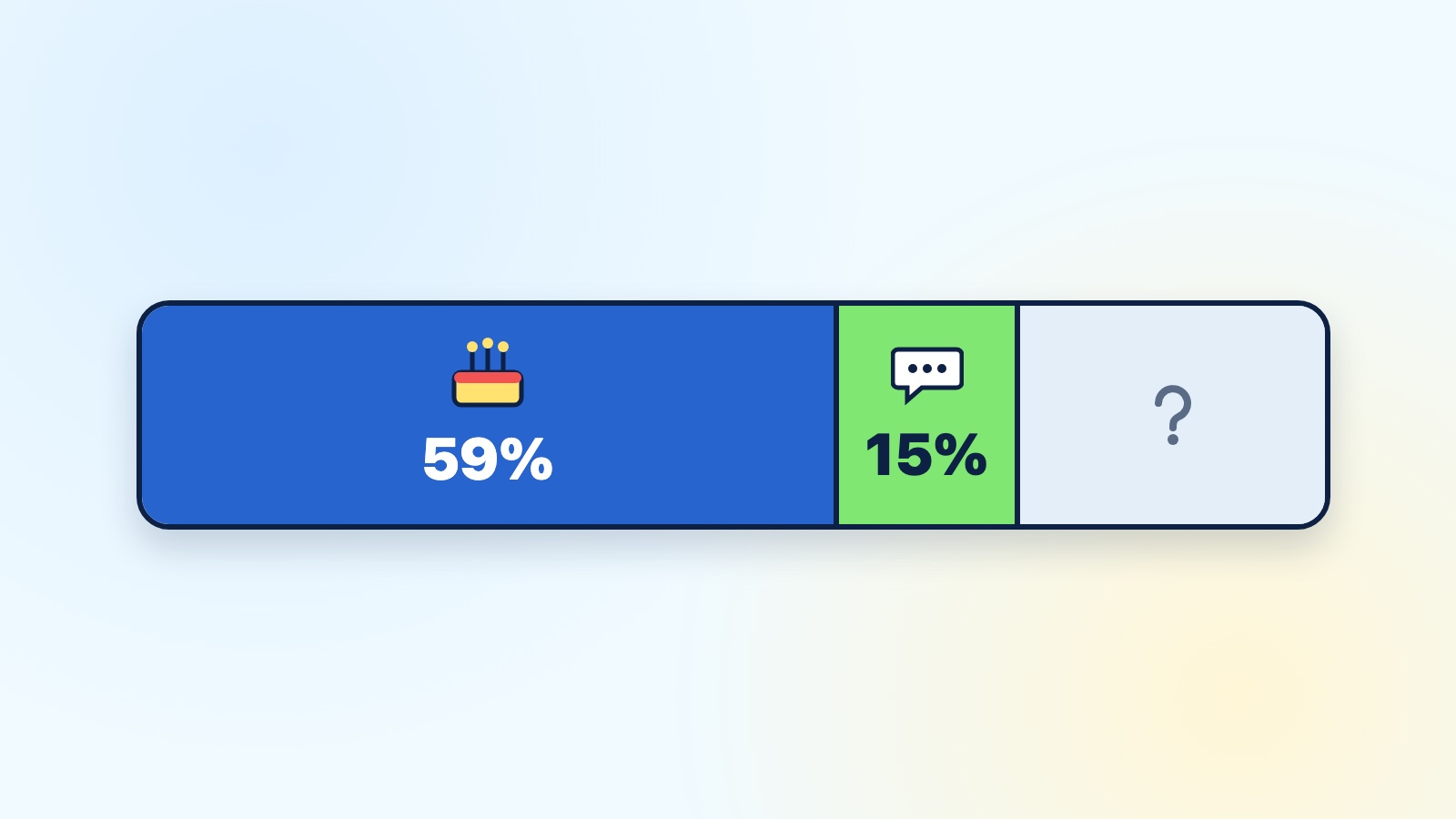
What explained differences in accent among 240 Italian speakers of English in Canada: the age they started learning (59%), how much they used each language (15%), and everything else (Flege, Munro & MacKay, 1995).
Classrooms are a different world
Almost all of the studies above looked at immigrants surrounded by the new language all day. Carmen Muñoz points out that findings from these settings have been too quickly applied to classrooms, where learners usually get far less exposure. There, she argues, the amount and quality of input make a big difference to how age plays out (Muñoz, 2008). Starting early with one lesson a week is not the same as moving abroad at six.
So, is it too late?
Put together, the honest answer looks like this:
- Age matters most for the last few percent. If your goal is to be indistinguishable from a native speaker in grammar and accent, starting early helps a lot, and it is rare after the teen years.
- Age does not stop you from learning. Adults made the fastest early progress in Snow and Hoefnagel-Höhle's study, and grammar-learning ability held until about 17 in Hartshorne's data, then declined gradually.
- Time and use matter at every age. Natives kept improving until about 30. Use explained part of accent differences. In classrooms, input shapes everything.
How to use this today
- Pick a goal age does not control. "Order dinner in Japanese," "follow a Korean drama without subtitles" and "chat with my Spanish-speaking in-laws" are all within reach at any age. "Pass as a native under laboratory testing" is not a fair yardstick for anyone.
- Use your adult head start. You can understand rules, plan your practice and use proven techniques like spaced repetition and retrieval practice. Children cannot do those deliberately.
- Get lots of input, every day. Years of exposure drive the final level, so a little every day beats an occasional marathon. Listen and read things you mostly understand.
- Work on pronunciation directly. Accent is the most age-sensitive part, so do not leave it to chance. Practice saying things out loud and compare yourself to a recording (more on that in how speaking practice works in Miaru).
- If you have kids, start them early, and keep it going. Early starts pay off over many years of real use, not from a few early lessons alone.
Try it in Miaru
Miaru is built for learners of any age: short daily lessons, reviews that come back right before you would forget (see how Miaru brings your words back), and, with Miaru Plus, calls where you say your lines out loud and get each one scored. On the cover, Luffy has opened the window at five to midnight, and the words are still coming in.
References
- Abrahamsson, N., & Hyltenstam, K. (2009). Age of onset and nativelikeness in a second language: Listener perception versus linguistic scrutiny. Language Learning, 59(2), 249–306. https://doi.org/10.1111/j.1467-9922.2009.00507.x
- Flege, J. E., Munro, M. J., & MacKay, I. R. A. (1995). Factors affecting strength of perceived foreign accent in a second language. The Journal of the Acoustical Society of America, 97(5), 3125–3134. https://doi.org/10.1121/1.413041
- Hartshorne, J. K., Tenenbaum, J. B., & Pinker, S. (2018). A critical period for second language acquisition: Evidence from 2/3 million English speakers. Cognition, 177, 263–277. https://doi.org/10.1016/j.cognition.2018.04.007
- Johnson, J. S., & Newport, E. L. (1989). Critical period effects in second language learning: The influence of maturational state on the acquisition of English as a second language. Cognitive Psychology, 21(1), 60–99. https://doi.org/10.1016/0010-0285(89)90003-0
- Muñoz, C. (2008). Symmetries and asymmetries of age effects in naturalistic and instructed L2 learning. Applied Linguistics, 29(4), 578–596. https://doi.org/10.1093/applin/amm056
- Snow, C. E., & Hoefnagel-Höhle, M. (1978). The critical period for language acquisition: Evidence from second language learning. Child Development, 49(4), 1114–1128. https://doi.org/10.2307/1128751
